Custom CRM vs Off-the-Shelf CRM: What Should You Choose?
By Relish Team
Custom CRM vs Off-the-Shelf CRM: What Should You Choose?
Choosing a CRM feels simple in the beginning. You sign up for a popular platform, create a few pipelines, add contacts, and start tracking leads. For most businesses, that’s enough to get started.
But as your team grows, the CRM starts becoming more than a tool. It becomes the core system behind your sales process, customer follow-ups, and reporting. That’s when businesses run into a real problem: the CRM that felt easy at the start begins to slow everything down.
So the real question becomes: should you keep using an off-the-shelf CRM, or move to a custom CRM that fits your business workflow perfectly?
This blog will help you decide clearly—based on scale, efficiency, reporting, and long-term cost.
Why CRM decisions become expensive later
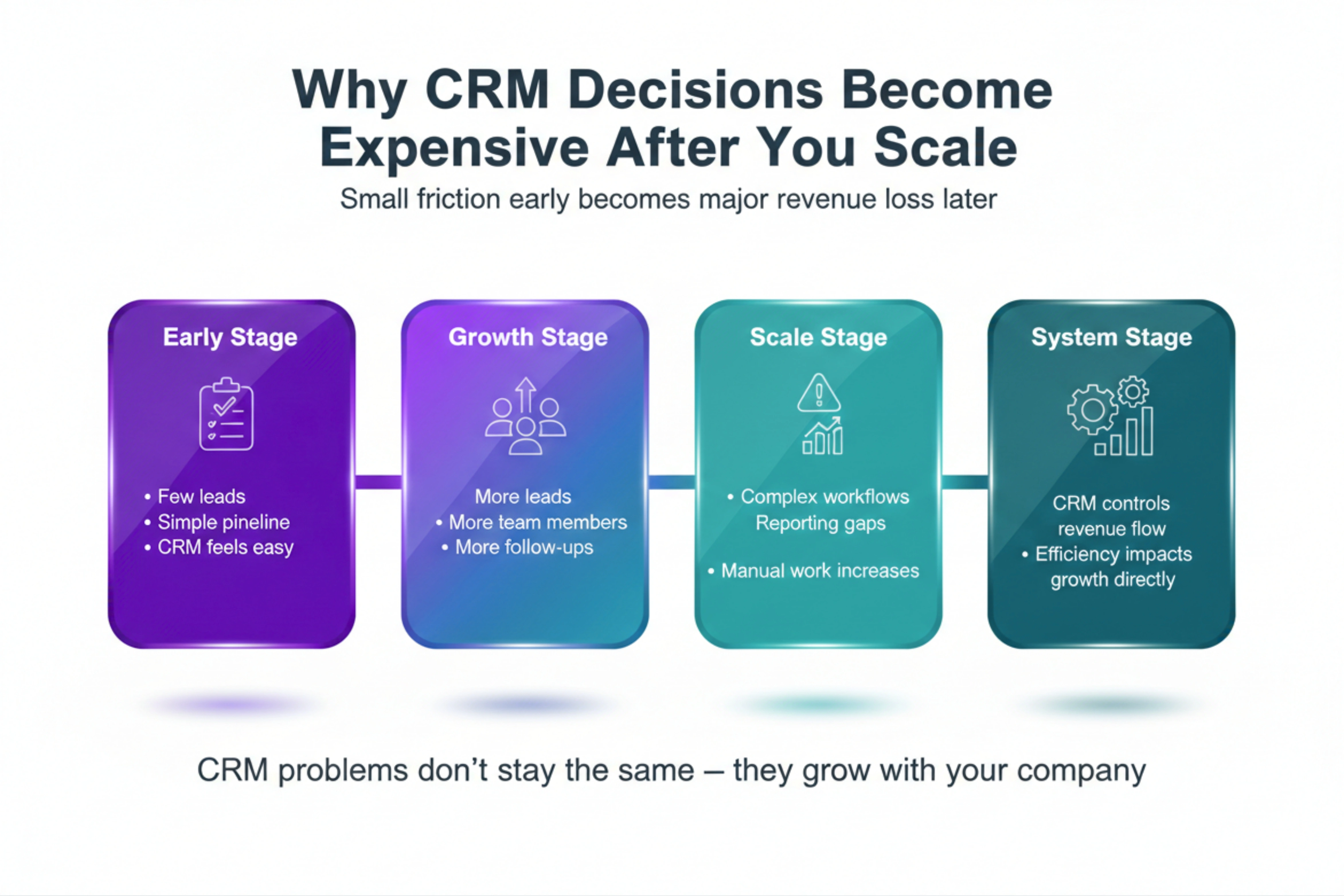
CRM issues don’t show up on Day 1. They show up after months of usage, when you have more leads, more follow-ups, multiple team members, and more stages in your process.At that stage, a CRM can either make your sales faster or turn every action into manual work. Teams start wasting time fixing data, updating statuses, searching for information, and building workarounds instead of focusing on closing deals.
The biggest mistake businesses make is thinking they can “fix it later.” CRM problems don’t stay the same—they grow with your company.
What is an off-the-shelf CRM?
An off-the-shelf CRM is a ready-made system you can subscribe to and use immediately. It’s designed to serve a wide variety of businesses, which means it comes with standard pipelines, standard reporting, and standard automation features.
Off-the-shelf CRMs are most useful when your process is simple, your sales cycle is short, and you want to get organized quickly. They’re also great when you’re still figuring out how your internal workflow should look.
However, the more your process becomes unique, the more you’ll start feeling friction. You may notice that the CRM forces you to work in a certain way, even when it doesn’t match how your team operates. Over time, this creates inefficiency and inconsistent data.
What is a custom CRM?
A custom CRM is built around your exact business workflow. Instead of adapting your team to the tool, you build the tool to match your team.
This is important because no two businesses run sales in the exact same way. A real estate company qualifies leads differently than a B2B service company. A multi-location business tracks customer history differently than a SaaS startup. A custom CRM is designed for those differences.
A well-built custom CRM typically includes role-based access, automation rules that reflect your pipeline, and dashboards that reflect your KPIs—not generic reporting templates.
When businesses reach a certain stage, custom CRM becomes less of a “nice-to-have” and more of a system that protects revenue and saves hours every week.
Custom CRM vs off-the-shelf CRM: the real differences
To make the decision easier, think in terms of what happens after you scale.
Setup time and cost
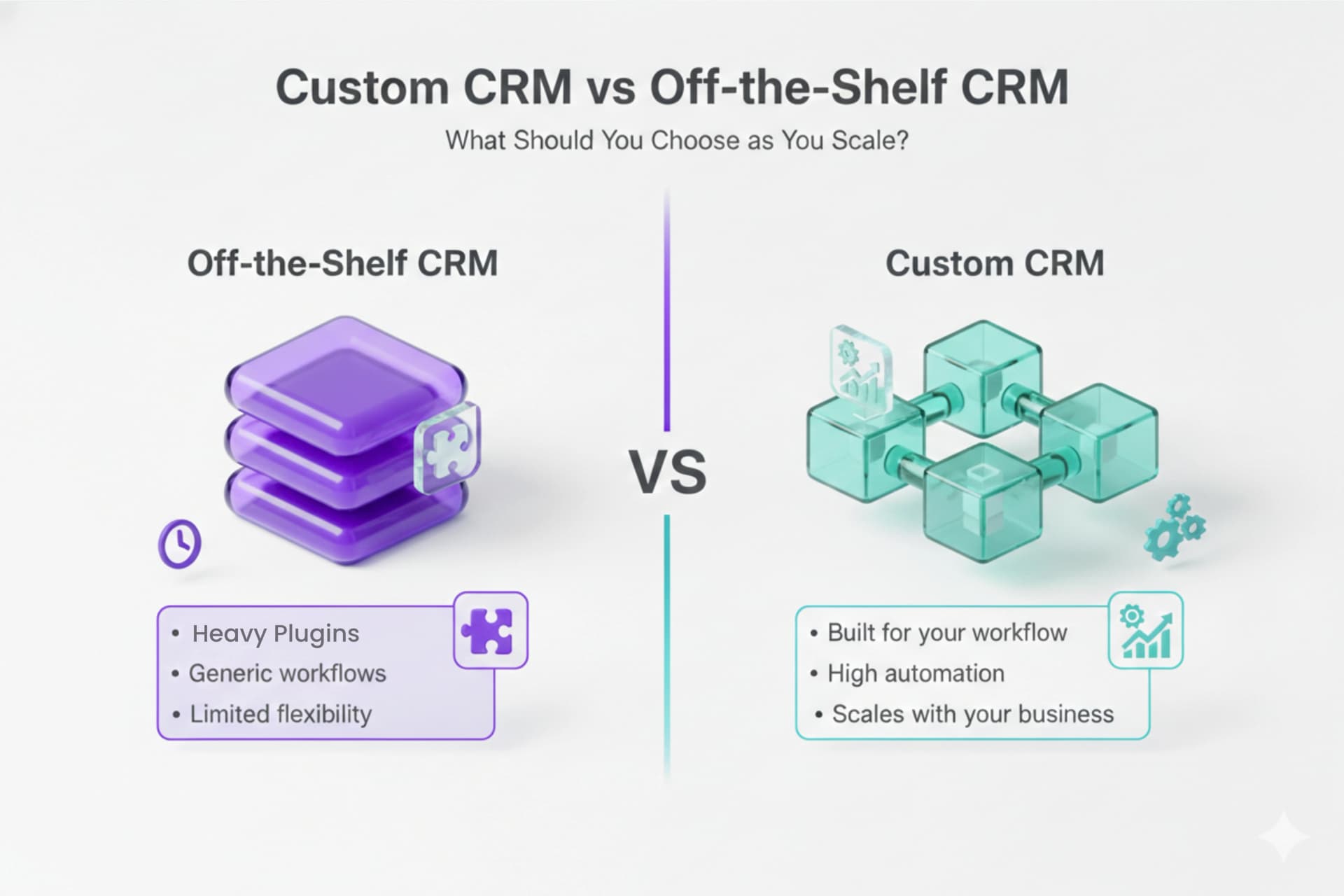
An off-the-shelf CRM is faster to set up and has a lower starting cost. You can onboard your team quickly and start tracking leads within days.
A custom CRM takes longer because it is built intentionally. It has a higher upfront cost, but it can save money long-term, especially when your team grows and per-user subscriptions start becoming expensive.
Workflow fit and flexibility
Off-the-shelf CRMs are built for general workflows. You can customize them, but only up to a limit. Once you need complex logic, multiple teams, or non-standard stages, your CRM starts feeling restrictive.
Custom CRMs are built for your workflow from the beginning. That means you can add exactly what your business needs and remove everything you don’t. It becomes simpler over time, not more complicated.
Automation and integrations
Most CRMs offer automation. But automation only works well when it matches your process.
If your sales process includes lead distribution rules, custom follow-up logic, WhatsApp or email integration, internal approvals, or multi-team handoffs, off-the-shelf CRMs often require workarounds. Custom CRMs can automate these flows smoothly because they are designed for your operations.
Reporting and forecasting accuracy
This is where businesses feel the biggest gap.
Off-the-shelf CRMs usually offer standard dashboards. They look fine, but they rarely answer the real questions leadership asks, like:
- Which lead sources actually close revenue, not just generate leads?
- Which pipeline stage causes the most drop-offs?
- What is our true forecast for the next 30 days?
- What is the average time to close by lead type?
A custom CRM can be built to report exactly on what your business needs to measure. This improves decision-making because you stop guessing and start managing the pipeline using clean, accurate data.
If your business is at the stage where your CRM needs better workflows, dashboards, and automation, this is where a structured CRM development service becomes relevant.
Which CRM should a growing business choose?
Here’s a clean way to decide without overthinking.
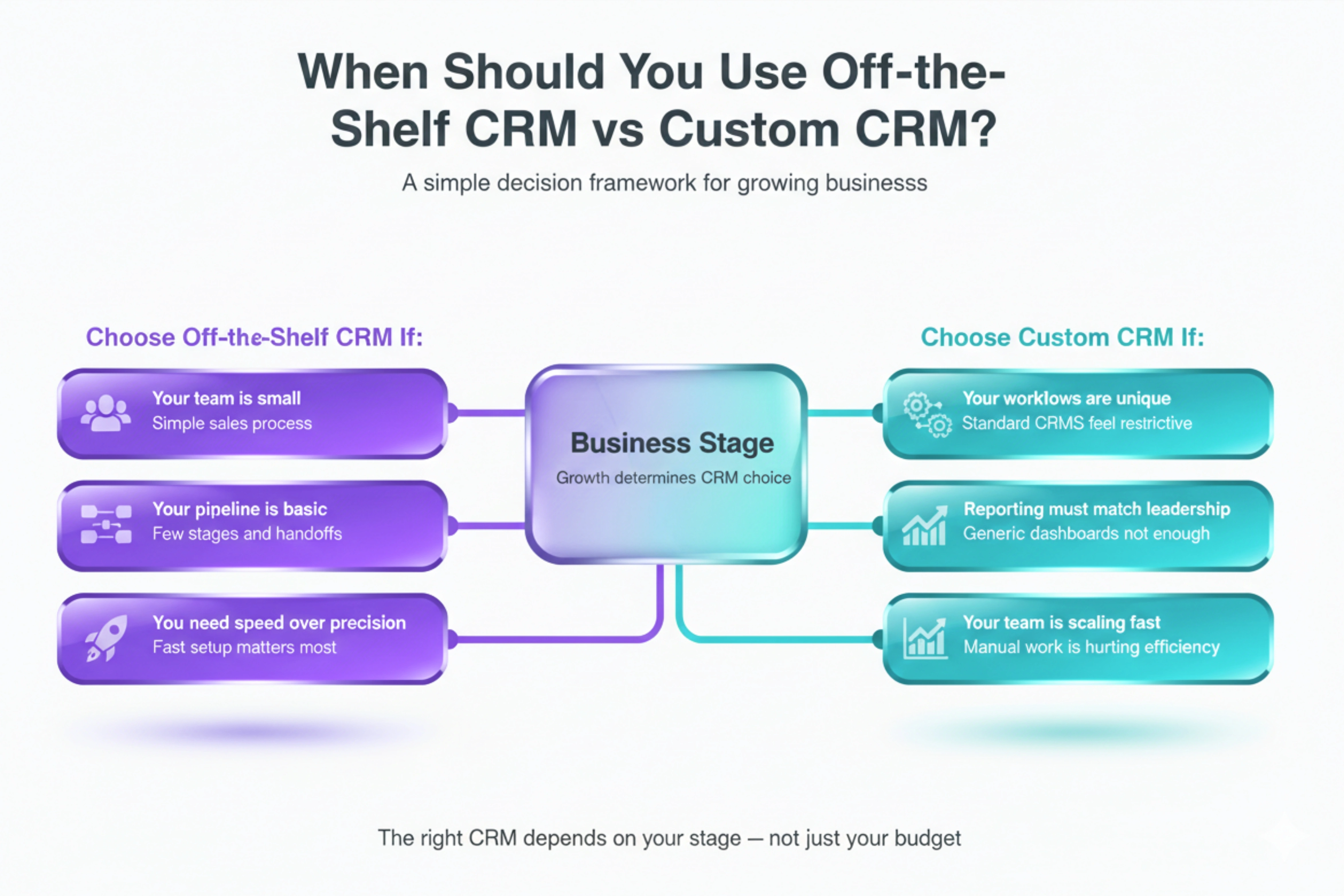
If your business is still early-stage and your process is simple, an off-the-shelf CRM is a smart choice. It helps you build structure quickly and gets your team into the habit of tracking everything properly.
But if your business has reached a point where your team spends too much time maintaining the CRM, reporting feels unreliable, or workflows don’t match real operations, custom CRM becomes the better option.
The best CRM is the one that saves time daily, reduces lead leakage, and gives you visibility you can trust.
A hybrid approach that many businesses miss
You don’t always have to pick only one option.
Many businesses start with an off-the-shelf CRM to get organized. Then as they scale, they build custom modules around it—like custom dashboards, automation layers, or integration systems.
This hybrid approach can work well if you want speed now and flexibility later.
Final thoughts
A CRM should help your business operate faster, not create friction. Off-the-shelf CRMs are great for quick setup and simple processes. But as your team grows and workflows become more complex, custom CRMs can improve automation, reporting accuracy, and overall efficiency.
The right choice depends on your stage, your process complexity, and how much control you need over workflow and data. When you choose the CRM that matches your operations, your sales pipeline becomes easier to manage and easier to scale.