
The Hidden Cost of Poor UX in SaaS and Business Platforms
By Relish Team
Most businesses think of UX as a design upgrade — colors, layouts, visual polish.
But in SaaS and business platforms, poor UX isn't cosmetic.
It quietly drains revenue, productivity, trust, and growth.
The real danger?
These losses rarely show up in obvious reports. They hide inside churn rates, onboarding friction, support tickets, and disengaged users.
Let's unpack what poor UX is actually costing — and why smart companies treat it as a business problem, not a design preference.
Where UX Problems Actually Hurt the Business
Poor UX doesn't scream. It leaks value slowly.
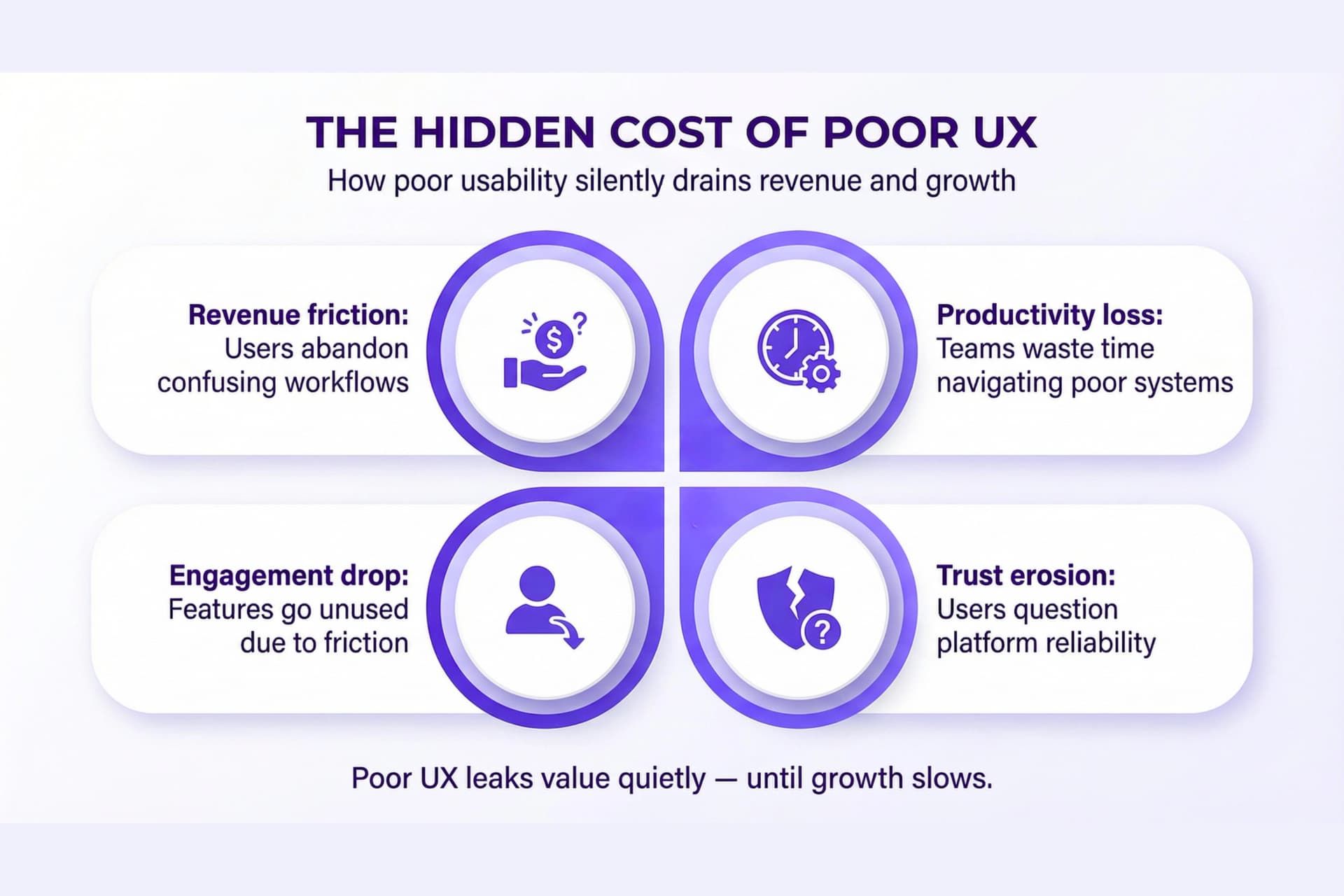
Revenue Friction
Users abandon tasks when interfaces feel confusing or slow.
That means:
- Incomplete signups
- Failed purchases
- Abandoned workflows
Even small friction multiplies across thousands of interactions.
Productivity Loss Inside Teams
Business platforms with clunky UX force employees to:
- Repeat actions
- Search endlessly
- Make avoidable mistakes
Time lost per task becomes hours lost per week. That's operational cost disguised as inefficiency.
Customer Trust Erosion
When users struggle, confidence drops.
They begin to question:
- Platform reliability
- Data accuracy
- Long-term usability
Trust is fragile — poor UX accelerates doubt.
The Silent Metrics That Reveal UX Damage
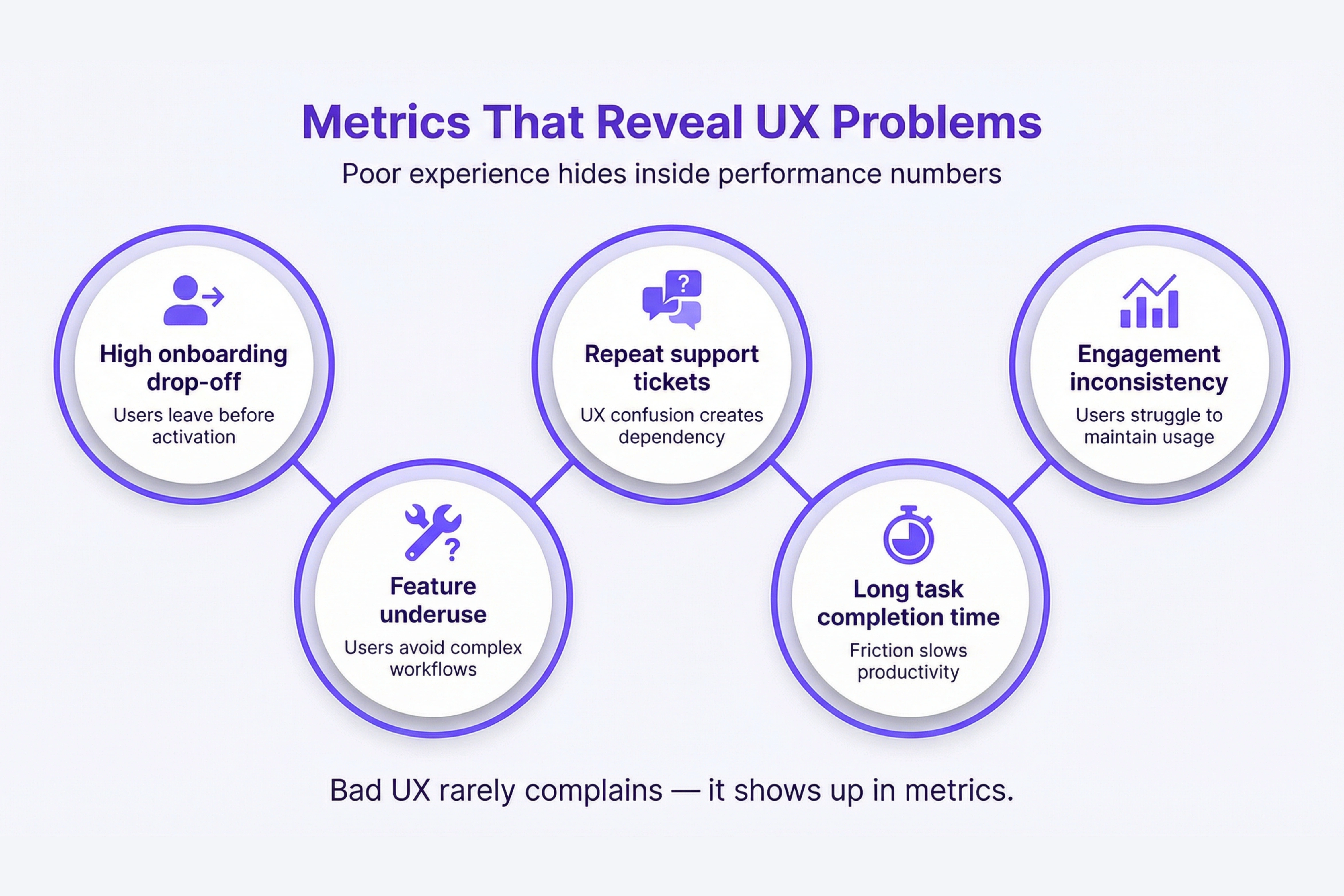
Poor UX often hides in indirect signals.
Watch for:
- High onboarding drop-off
- Feature underuse
- Repeat support requests
- Long task completion time
- Inconsistent engagement
These metrics aren't "UX complaints" — they're business alarms.
Why SaaS Platforms Feel UX Pain More Than Others
SaaS platforms aren't single-use experiences. They're daily tools.
That means:
👉 Every friction point compounds 👉 Every confusion repeats 👉 Every inefficiency scales
Unlike casual apps, SaaS UX directly influences adoption speed, retention, and expansion revenue.
A product can be powerful — but unusable power still drives churn.
Common UX Mistakes That Create Hidden Costs
Feature Overload
Trying to show everything at once overwhelms users. Result: Cognitive fatigue and slower decision-making.Poor Onboarding Flow
Users don't understand value quickly enough. Result: Drop-off before activation.Inconsistent Navigation
Users waste time relearning workflows. Result: Frustration and inefficiency.Weak Feedback Systems
Users don't know what actions succeeded. Result: Hesitation and avoidable errors.A Practical Framework to Evaluate UX Impact
Instead of asking: *"Does the interface look good?"*
Ask:
Clarity — Can users instantly understand what to do? Efficiency — Can tasks be completed with minimal friction? Confidence — Do users trust their actions and outcomes? Consistency — Does behavior feel predictable across the platform? Scalability — Can UX support growth and complexity?If any of these fail, business performance suffers.
Real-World Scenario: UX Cost in Action
Imagine a CRM platform where:
- Onboarding takes 20 minutes instead of 5
- Dashboards require multiple clicks for simple insights
- Actions lack confirmation feedback
Individually, these feel minor.
Collectively, they cause reduced adoption, employee resistance, and lower perceived value.
That's not a UX inconvenience — that's operational drag.
Turning UX Into a Business Advantage
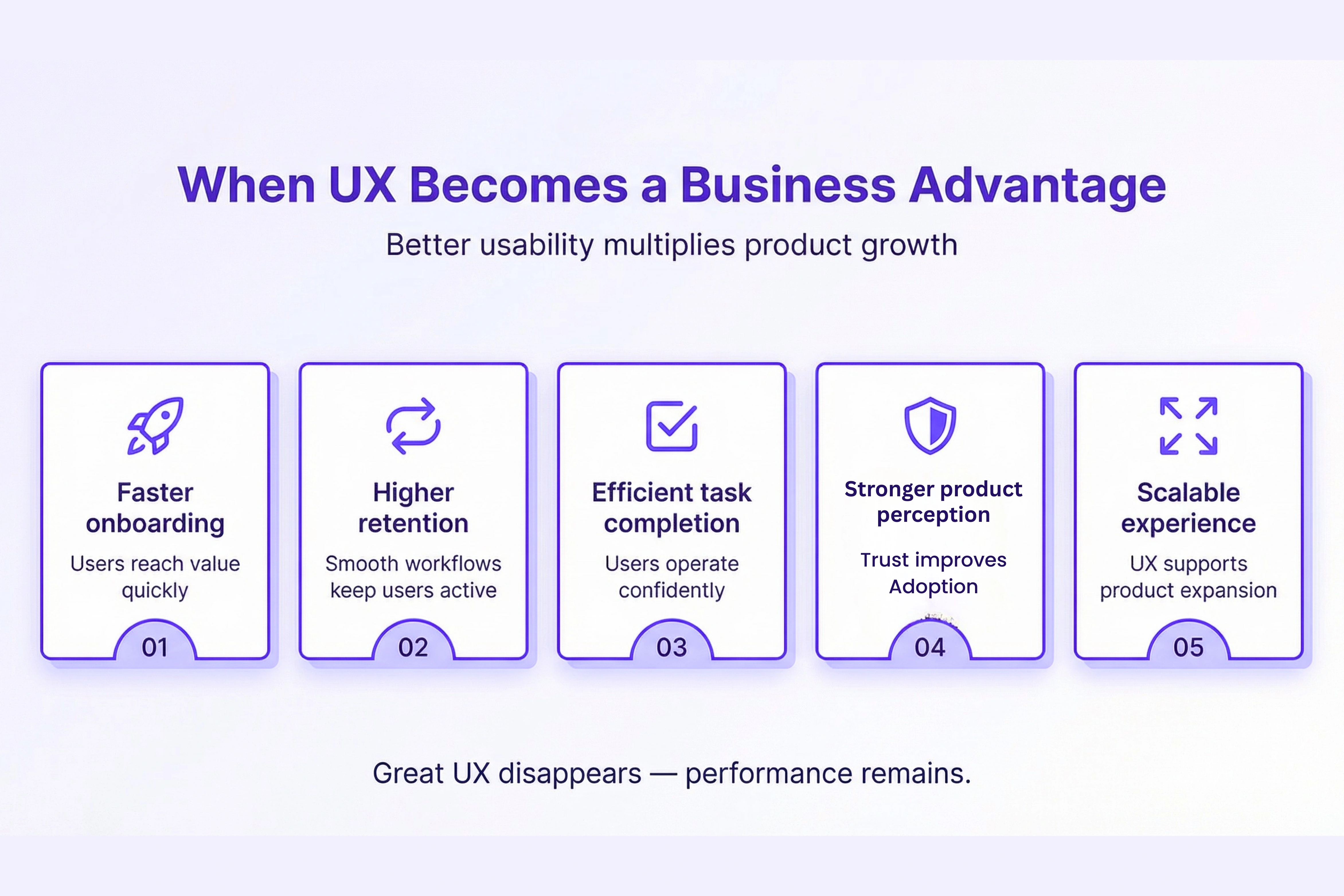
Companies that treat UX as infrastructure see:
- Faster onboarding
- Higher retention
- Better task completion
- Stronger product perception
UX becomes a performance multiplier, not a design layer.
Designing for Growth Instead of Survival
Good UX doesn't just fix pain.
It enables:
- Smoother scaling
- Feature expansion
- Cross-platform consistency
- Long-term adaptability
Platforms built with UX intent don't fight growth — they support it.
That's the difference between reactive design and strategic product thinking.
When UX Starts Driving Business Momentum
The most successful think of UX as a design upgradSaaS platforms don't win because they have more features.
They win because users understand them quickly, trust them instinctively, operate efficiently, and stay longer.
UX becomes invisible — and that's its greatest power.
When usability disappears, performance shines.
Teams that embed UX thinking into their product strategy — not just their design phase — consistently build platforms that retain users, reduce friction, and scale without breaking.
