
The Website Conversion Framework: From Visitor to Customer
By Relish Team
Getting traffic to your website is the easy part. Most businesses figure that out eventually — through SEO, paid ads, social content, or referrals. The harder problem, and the one that costs far more money over time, is what happens after someone arrives.
The average website converts between 2% and 4% of its visitors. That means for every 100 people who land on your site, 96 leave without doing anything. Most businesses respond by buying more traffic. The smarter response is fixing what's already broken.
This is the conversion framework — not as a list of tactics, but as a structured way of thinking about the journey from stranger to customer, and where that journey most commonly falls apart.
The Three Stages Every Visitor Moves Through
Before optimising anything, it helps to understand what a visitor is actually doing when they land on your site. They're not ready to buy. They're running a rapid, mostly unconscious evaluation.
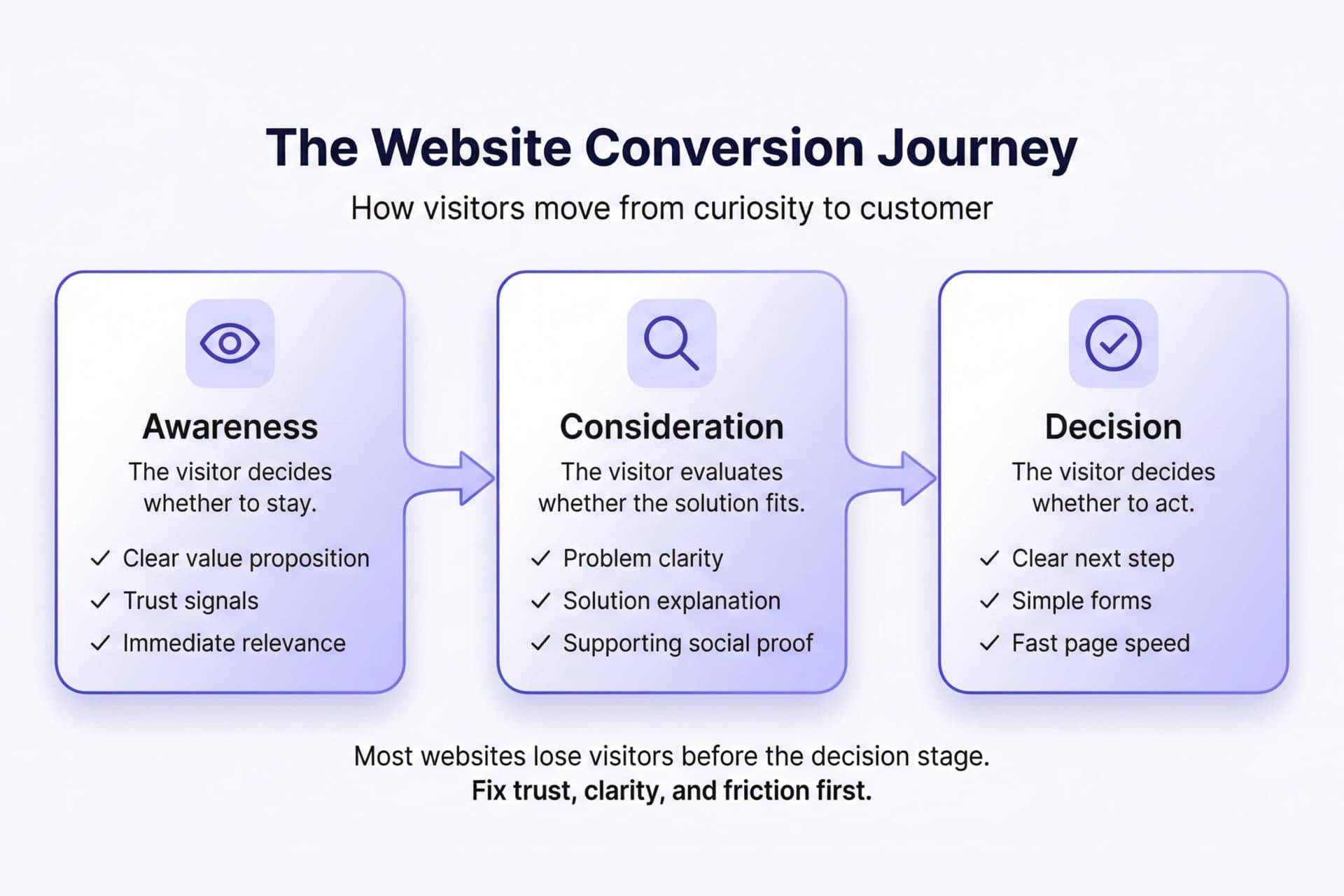
Every visitor moves through three stages:
- Awareness — they've arrived and they're answering one question: Do I trust this place enough to stay?
- Consideration — they're engaged and answering: Is this the right solution for my problem?
- Decision — they're ready to act and answering: Is it easy and safe enough to take the next step?
Most websites fail at stage one. The visitor doesn't trust the page fast enough and leaves within seconds. Some fail at stage two — the content doesn't connect the product to the reader's specific problem. A smaller number fail at stage three — the action is buried, confusing, or asks for too much too soon.
Knowing where your site fails is the first step to fixing it.
Stage One — The First Eight Seconds
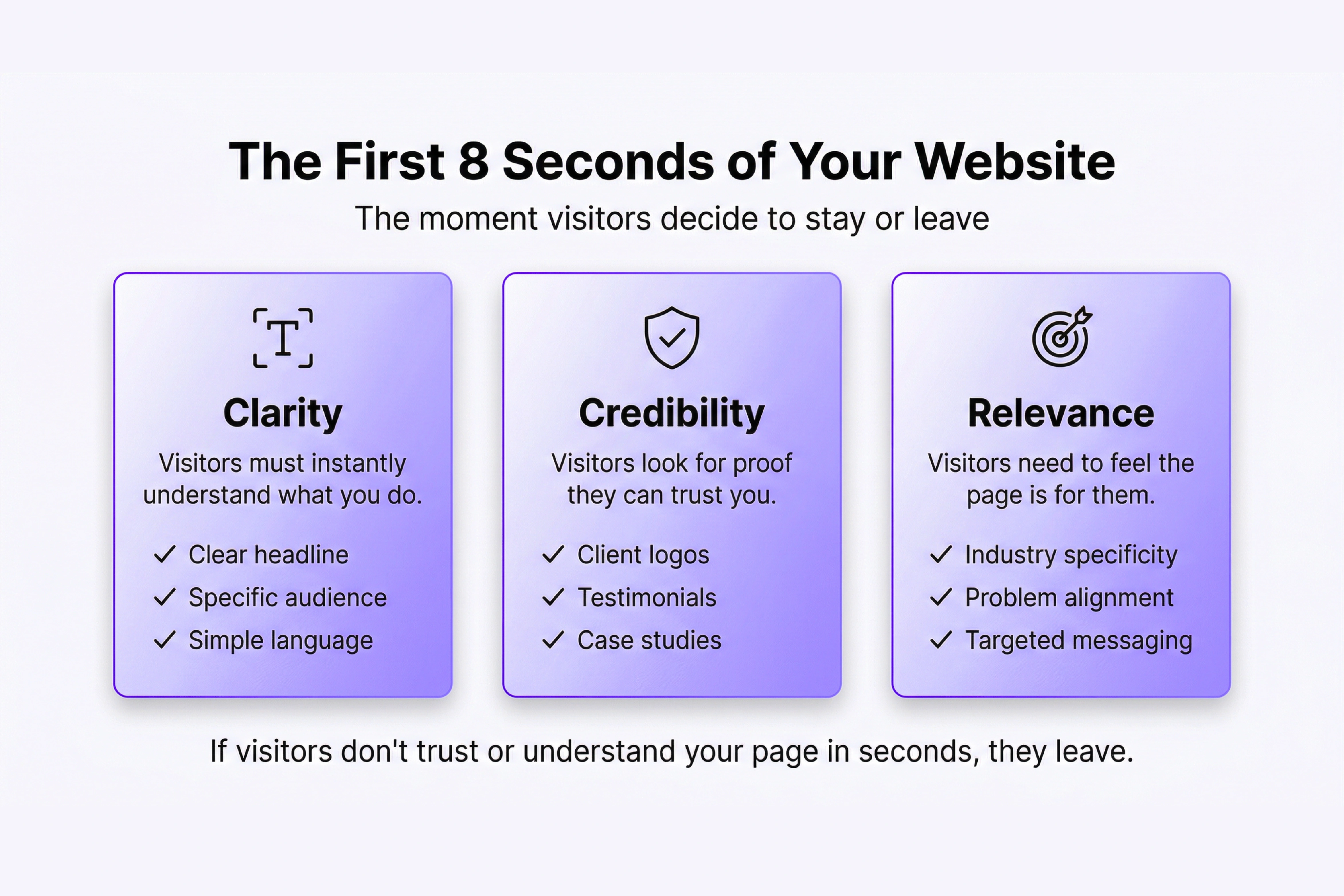
Research consistently shows that visitors decide whether to stay or leave within seconds of arriving. That decision is made almost entirely on three things: clarity, credibility, and relevance.
Clarity — Can They Understand What You Do?
Your hero section — the first thing visible without scrolling — must answer one question without ambiguity: What do you do, and who is it for?
"We build innovative digital solutions for forward-thinking businesses" says nothing. "We build websites and apps for UAE startups that need to launch fast" says everything.
The more specific your opening statement, the higher your conversion rate. Specificity feels like risk because it excludes some visitors. What it actually does is convert the right visitors at a dramatically higher rate.
Credibility — Should They Trust You?
Credibility signals need to appear early — ideally above the fold. These include: client logos, case study references, years of experience, awards, testimonials from recognisable names, or simply a professional visual standard that signals the business is real and serious.
A visitor who can't quickly answer "have other people trusted this company?" will not convert. Trust is not built through claims — it's built through evidence.
Relevance — Is This For Me?
Even a clear, credible page fails to convert if the visitor doesn't see themselves in it. This is the relevance question: does this feel like it was built for my type of problem, industry, or situation?
The answer lives in specificity of language. If your ideal customer is a Dubai-based founder launching a SaaS product, say that — don't hide it behind generic language about "growing businesses globally."
Stage Two — Building the Case
If a visitor makes it past the first eight seconds, they've given you permission to make your case. Stage two is where most well-designed websites still lose people — because they list features rather than solving problems.
Lead With the Problem, Not the Product
Every service you offer exists because a customer had a problem. The conversion mistake is describing the solution before the visitor has felt understood about the problem. Lead with the pain — the specific frustration, the wasted money, the missed opportunity — and the solution lands with weight.
A web development agency that opens with "we build high-performance websites" is describing itself. One that opens with "most business websites look professional but quietly lose customers at every stage" is talking to the visitor.
Social Proof at the Moment of Doubt
Social proof is most powerful when it appears at the exact moment a visitor is likely to hesitate. Testimonials buried at the bottom of a page are decoration. Testimonials placed next to a pricing section, next to a contact form, or next to a bold claim are conversion tools.
The most effective social proof is specific: not "great service" but "we went from 1.2% to 4.7% conversion rate after the redesign." Specific outcomes reduce anxiety and replace hesitation with momentum.
Stage Three — Removing Friction From the Decision
A visitor who has made it through stages one and two wants to take action. Stage three is about not getting in the way.
One Clear Next Step
The single biggest conversion killer is a page that asks visitors to do too many things at once. Multiple CTAs compete with each other and produce decision paralysis. Every page should have one primary call to action — and that action should be the logical next step for someone at that stage of the journey, not the biggest ask you can make.
A visitor on a blog post should be asked to read another piece of content or subscribe. A visitor on a services page should be asked to book a call or get a proposal. A visitor on a case study should be asked to see more work or start a conversation.
Match the ask to the stage. Don't propose on the first date.
Reduce What You Ask For
Every field in a form, every step in a process, and every piece of information you require is friction. Friction kills conversions at the exact moment the visitor has decided to act.
For most service businesses, the only information you need at the enquiry stage is a name, an email, and a brief description of the project. That's it. Everything else can come after the first conversation.
Speed Is a Conversion Variable
A one-second delay in page load time reduces conversions by up to 7%. In a mobile-first market like the UAE — where most web traffic comes from phones on 4G or 5G connections — a slow website is a direct revenue leak. Performance is not a technical concern. It's a commercial one.
The Conversion Problem Most Businesses Miss
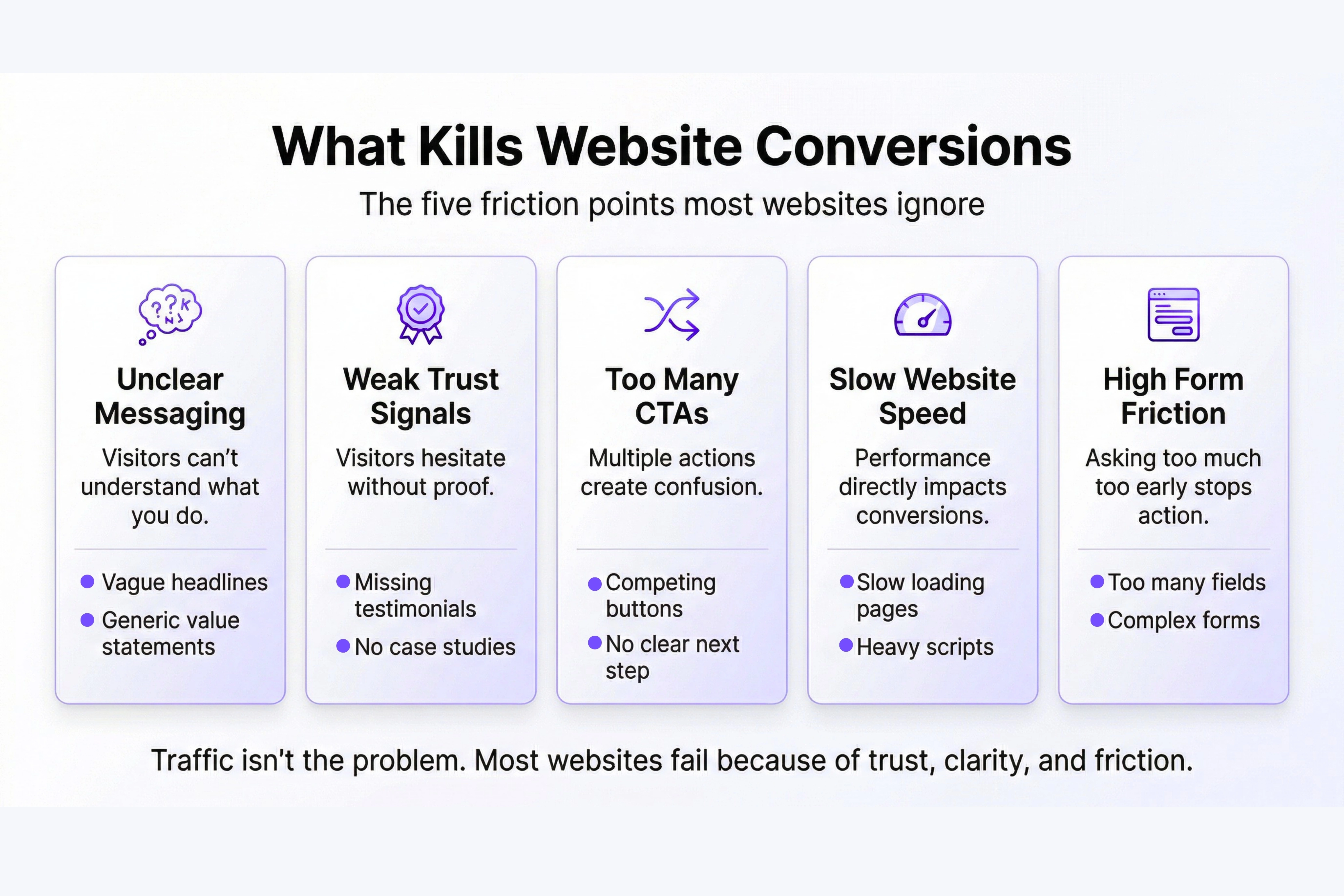
Here's what the data consistently shows: most websites don't have a traffic problem. They have a trust problem, a clarity problem, or a friction problem — often all three at once.
And all three trace back to the same root cause: the website was designed to look good rather than to do a job. The brand wasn't defined before the wireframe was built. The copy was written around what the business does, not what the customer needs. The journey was designed by a developer, not a strategist.
Conversion optimisation done properly is not a set of tweaks applied after launch. It's a discipline that starts in discovery — understanding the visitor, their problem, and what they need to see at each stage before any design begins.
At Relish, we build websites and digital products where brand strategy, user experience, and conversion thinking are integrated from the start — not bolted on after the fact. If your site is getting traffic but not converting, let's look at why.,
Because more traffic sent to a broken funnel is just more money leaving through the same hole.
