
What UAE Startups Get Wrong About Branding Before They Launch
By Relish Team
Most UAE founders launch with a logo, a colour palette, and an Instagram page — and call it a brand.
Most of them also look identical within six months.
The UAE produces thousands of new businesses every year. Dubai alone registered over 50,000 new companies in 2024. The mistake isn't effort — founders here work hard, move fast, and invest real money. The mistake is sequence and understanding: getting the logo before the strategy, designing for the wrong audience, and mistaking visual polish for positioning.
Here's what gets wrong most often, and what to do instead.
Mistaking a Logo for a Brand
This is the most universal branding mistake — but it hits UAE startups particularly hard because the market here is so visually saturated. Dubai is a city of extraordinary aesthetics: luxury towers, five-star everything, and brands competing on how good they look. Founders absorb this and conclude that looking premium is the goal.
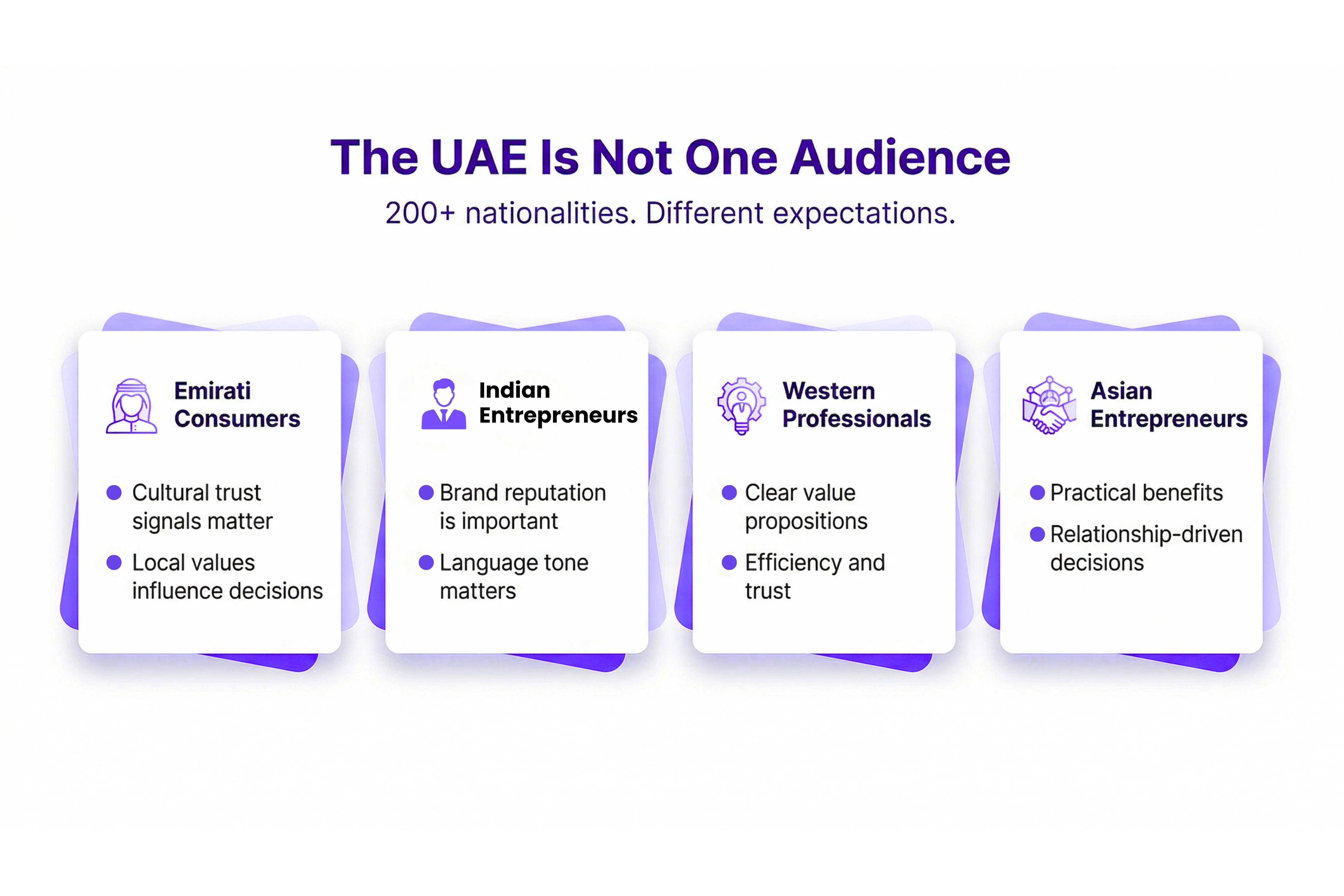
It isn't. Looking premium is the output. The goal is being clearly positioned — knowing exactly who you're for, what you stand for, and why someone in a market of 200+ nationalities should choose you over the ten similar businesses that launched last month.
A logo cannot carry that weight alone. Brand strategy can.
What a Logo Can't Do in This Market
- Build trust on its own
- Differentiate you from 10 competitors with similar logos
- Tell your audience why you exist or who you're for — especially in a market of 200+ nationalities
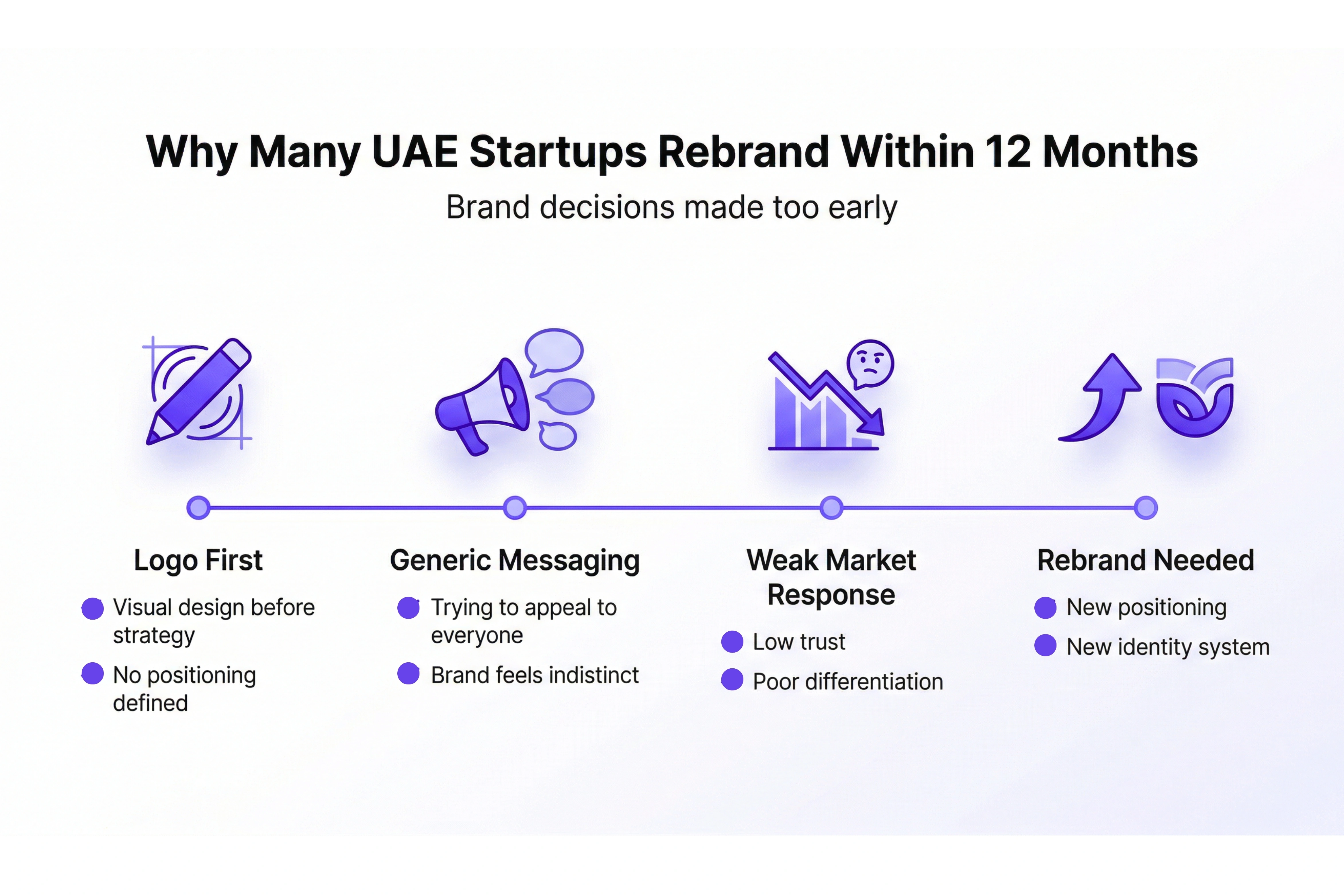
A logo designed without brand strategy behind it is a mark with no meaning. It looks the part but says nothing. This is why UAE businesses rebrand within two years of launching — not because the logo was poorly designed, but because it was designed before anyone knew what the brand was actually supposed to stand for.
Treating the UAE as One Audience
This is the mistake that's unique to this market — and it's a costly one.
The UAE is not a single consumer. It's 200+ nationalities living inside one country, each with different purchasing behaviours, cultural references, trust signals, and decision-making frameworks. An Emirati business owner, an Indian expat entrepreneur, a British finance professional, and a Filipino service worker all live within the same postcode — and they are not the same customer.
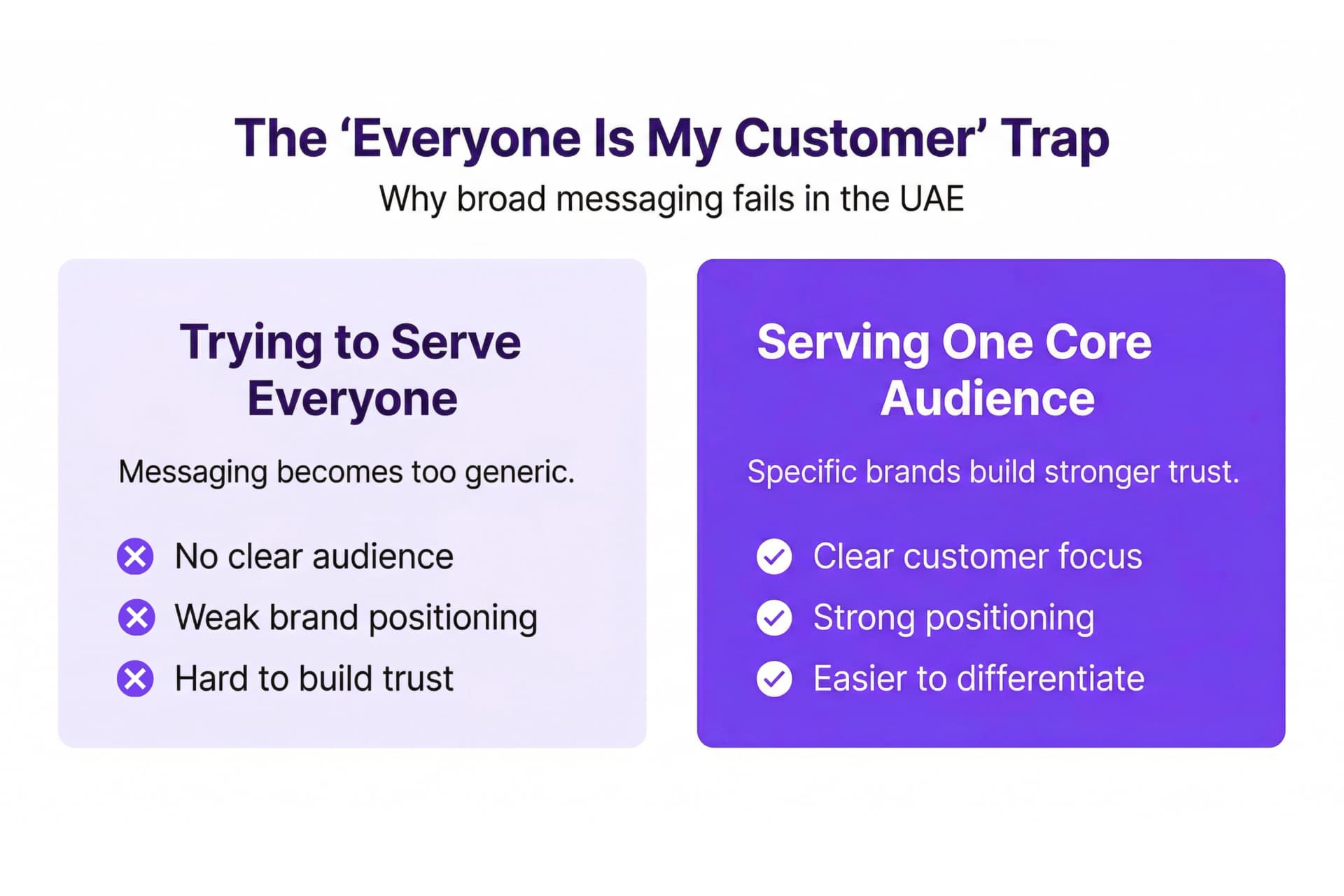
The "Everyone Is My Customer" Trap
Founders launching in the UAE often see the market's diversity as an opportunity to go broad. "We serve everyone" sounds like ambition. In practice, it produces branding that resonates with no one — messaging too generic to be trusted, visuals that could belong to any business in any city.
The brands that win in the UAE are ruthlessly specific about who their primary audience is. They build the brand for that person first — and let the breadth of the market bring others in naturally.
Ignoring Cultural Context in Messaging
Beyond audience definition, there's cultural sensitivity. The UAE is an Islamic country where Ramadan, National Day, and local hospitality codes shape how consumers respond to messaging. Brands that launch with purely Western-centric copy — direct, individualistic, benefit-driven — often land flat with both Emirati audiences and the Arab expat market.
This doesn't mean abandoning your voice. It means building a voice that was designed for this market, not copy-pasted from a Western playbook.
Building Brand Identity Before Brand Strategy
In the rush to launch, most UAE startups reverse the correct order.
They hire a designer. They choose colours they like. They pick a font that feels "premium" or "tech" or "friendly." The result looks professional — but it's built on nothing. No positioning. No defined audience. No reason to exist beyond the product itself.
Six months later, the brand doesn't convert, doesn't differentiate, and doesn't hold up when the business pivots or tries to scale into Saudi Arabia or beyond.
The correct order is:
> Strategy → Identity → Logo
Strategy defines who you are and who you're for. Identity expresses that visually and verbally. The logo gives it a mark. Without the first step, the other two are expensive guesswork.
Underestimating How Fast the UAE Market Moves
The UAE is one of the most competitive startup environments on earth. New entrants arrive constantly, investor money is accessible, and the market rewards brands that establish authority early. A vague brand in this market isn't neutral — it actively works against you.
When a potential client in Dubai is comparing three similar agencies or two similar apps, trust becomes the deciding factor. Trust is built through clarity: a brand that knows exactly what it is, who it's for, and why it exists differently. Brands that haven't done the strategic work signal uncertainty — and in a market this fast-moving, uncertainty loses.
Waiting Until Post-Launch to Think About Brand
The final mistake — and the one with the most lasting consequences — is treating brand as something to "sort out later" once revenue is coming in.
Brand is easiest and cheapest to build before launch. After launch, you're rebuilding on top of existing perception — correcting first impressions that have already formed with customers, investors, and partners. A rebrand six months in costs three to five times more than getting it right from the start, and it creates a gap in the market that competitors fill while you're rebuilding.
The best time to think about brand is before you've made any public-facing decisions at all. Before the name is locked. Before the website is built. Before the first investor deck goes out.
If that moment has passed, the second-best time is now.
What Should You Actually Do Before Launch?
It depends on where you are.
- Pre-launch, pre-revenue: Start with strategy before any public-facing decisions are made. Lock positioning before locking the name, the website, or the investor deck.
- Post-launch, pre-scale: This is the moment for a full brand strategy and identity review. You know who your customer is. Now build a brand system that can grow — and travel — with you.
- Established but invisible: You may not need a new logo. You may need a strategy refresh — to re-examine your positioning for this market and rebuild the system around it.
If you're building or rebuilding a brand in the UAE and want to understand what the right investment looks like at your stage, Relish offers brand strategy and identity engagements built for the region — integrated with the digital products that bring them to life.
To understand what a full brand engagement looks like, explore Relish's Brand Strategy & Identity service.
The One-Line Summary
A logo is a mark. Brand identity is a system. Brand strategy is the reason both of them work — and in the UAE, that work needs to happen before anything else does.
Most UAE startups buy a logo when what they actually need is strategy. Most agencies sell identity when what the client actually needs is thinking. Understanding the difference — and doing things in the right order, for the right market — is what separates brands that grow from brands that just look the part.
If you're pre-launch — or effectively launching again — get in touch before the logo brief goes out. Because in a market this competitive, your brand either earns attention on day one — or spends the next two years fighting for it.
