
Why High Traffic Pages Still Fail to Convert (SEO + UX Breakdown)
By Relish Team
Getting traffic feels like progress.
You open your analytics dashboard and see impressions climbing, clicks increasing, sessions flowing in — yet conversions remain flat.
This disconnect isn't rare. In fact, it's one of the most misunderstood performance gaps in digital marketing.
The truth is:
> Traffic brings people in. Experience determines whether they act.
High-traffic pages fail when SEO success isn't matched with intent clarity, usability, and decision flow. The good news? This gap is measurable — and fixable.
Let's break down what's really happening and how to diagnose it properly.
Traffic Success Can Hide Conversion Problems
Ranking well means your page answers a query. Converting well means it guides a decision.
A page can attract thousands of visitors who are:
- Researching
- Comparing options
- Validating ideas
...but if the page doesn't support their next step, momentum disappears.
This is where analytics tools reveal what rankings alone cannot.
Step 1 — Use Google Search Console to Validate Intent
Before blaming UX, confirm why users are arriving.
Open Google Search Console → Performance → Search results.
Look at search queries bringing traffic and ask:
- Do these queries match the page's purpose?
- Are users informational while the page pushes conversion?
- Is there intent misalignment?
If users search *"what is CRM software"* but land on a hard sales page, friction is inevitable.
Intent mismatch creates silent exits.
Step 2 — Use GA4 to Spot Engagement Friction
Next, shift to GA4 engagement metrics.
Navigate to Reports → Engagement → Pages and screens.
Evaluate:
Engagement rate — Low engagement suggests users don't find immediate relevance. Average engagement time — Short sessions signal hesitation or confusion. Conversion paths — Are users reaching decision points, or abandoning early?This isn't about bounce rate panic. It's about identifying where attention collapses.
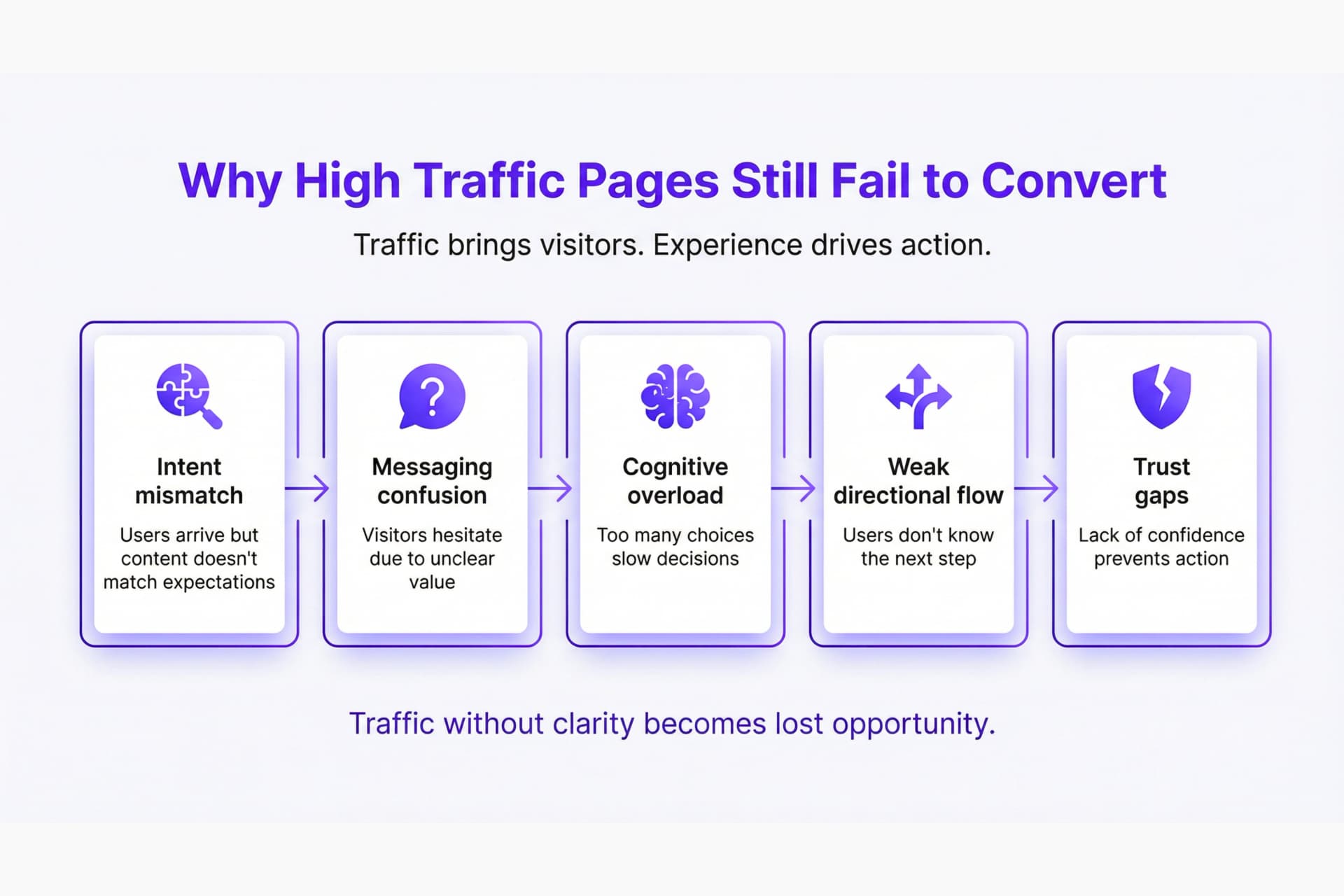
Where High-Traffic Pages Commonly Break
Once intent and engagement are visible, patterns emerge.
Messaging Disconnect
Visitors don't see immediate confirmation they're in the right place. Result: Hesitation → exit.Cognitive Overload
Too many competing elements slow decisions. Users shouldn't work to understand value.Weak Directional Flow
Pages inform — but don't guide. Users ask silently: *"What now?"*No answer = no conversion.
Trust Gaps
Missing clarity, reassurance, or logical progression introduces doubt. And doubt pauses action.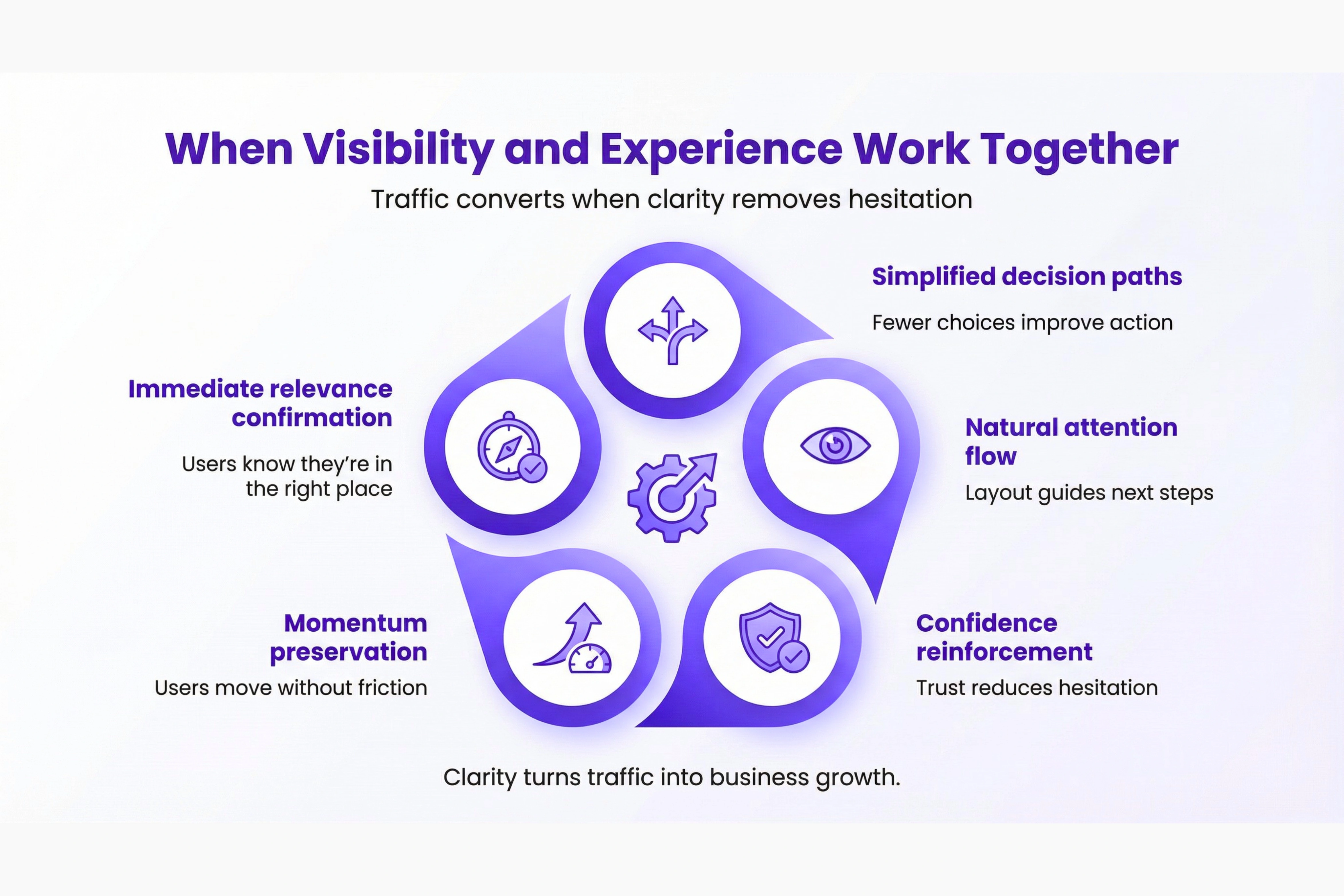
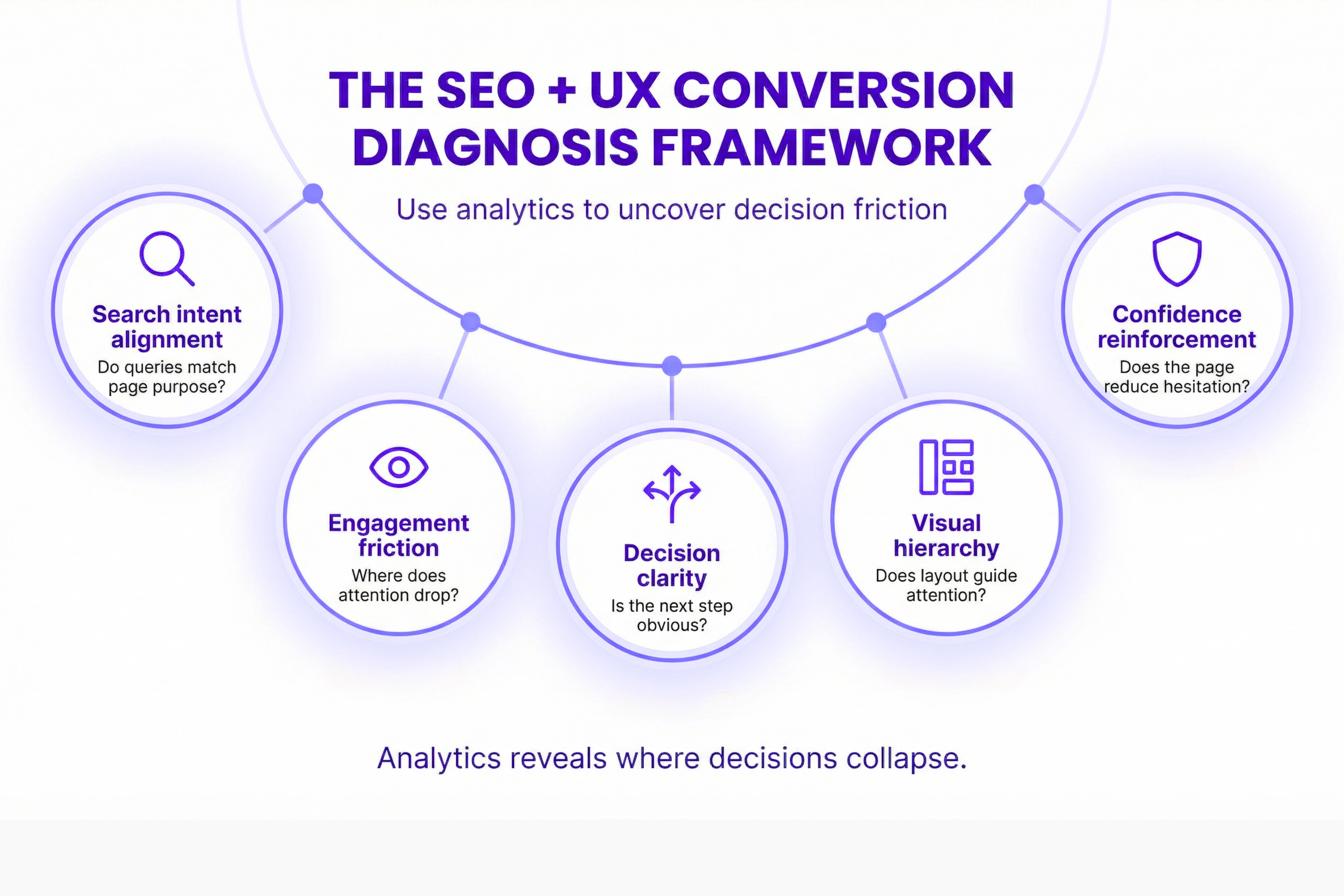
The Conversion Diagnosis Framework
Use this structured audit to evaluate any high-traffic page:
Intent alignment — Does the content match why users arrived? Decision clarity — Is the next step unmistakable? Visual hierarchy — Does layout guide attention naturally? Friction detection — Where do users pause or exit? Confidence reinforcement — Does the page reduce hesitation?When any layer fails, conversion weakens.
The Question Teams Eventually Ask
Why does my page rank well and attract visitors, but conversions stay low?
Because ranking solves discovery — not decision-making.
Conversions happen when intent alignment, UX flow, and confidence signals work together. Without those layers, traffic becomes curiosity instead of action.
Real Scenario: When SEO Metrics Mislead
A blog post ranks for a high-volume keyword. GSC shows strong impressions and clicks. GA4 shows rapid exits.
Diagnosis reveals:
- Informational queries landing on conversion-heavy content
- Unclear CTA positioning
- Dense layout overwhelming users
Traffic wasn't the issue. Experience was.
Turning Analytics Into Action
When GSC and GA4 insights guide UX changes, you unlock:
- Clearer intent matching
- Simplified decision pathways
- Stronger engagement flow
- Measurable conversion lift
Analytics isn't just reporting — it's behavioral insight.
Relish Developers' UX and performance optimization services help businesses translate analytics signals into actionable design improvements, refining flow, reducing friction, and converting existing traffic into meaningful outcomes.Designing Pages That Support Momentum
Great pages don't push users. They remove hesitation.
They:
- Confirm relevance immediately
- Simplify decisions
- Guide attention naturally
- Reinforce confidence
When friction disappears, conversion becomes the natural next step.
Traffic stops being a vanity metric — and starts becoming business leverage.
When Visibility and Experience Work Together
SEO opens the door. UX invites action.
The highest-performing pages align:
👉 Intent 👉 Clarity 👉 Flow
When those elements sync, traffic transforms into measurable growth — not just analytics noise.
That's precisely what a structured SEO and content strategy delivers — pages that rank and convert, not just rank.
