
Ecommerce Website Design: What Actually Drives Sales
By Relish Team
Most ecommerce businesses invest heavily in traffic — ads, SEO, social media — and comparatively little in the website those visitors land on. That is a problem. Because getting people to your store is only half the job. Getting them to buy is the other half, and that is almost entirely determined by how your website is designed.
This guide breaks down exactly which design decisions drive ecommerce sales, backed by real 2026 data, so you know where to invest and what to fix first.
What Is the Average Ecommerce Conversion Rate — and Why Should You Care?
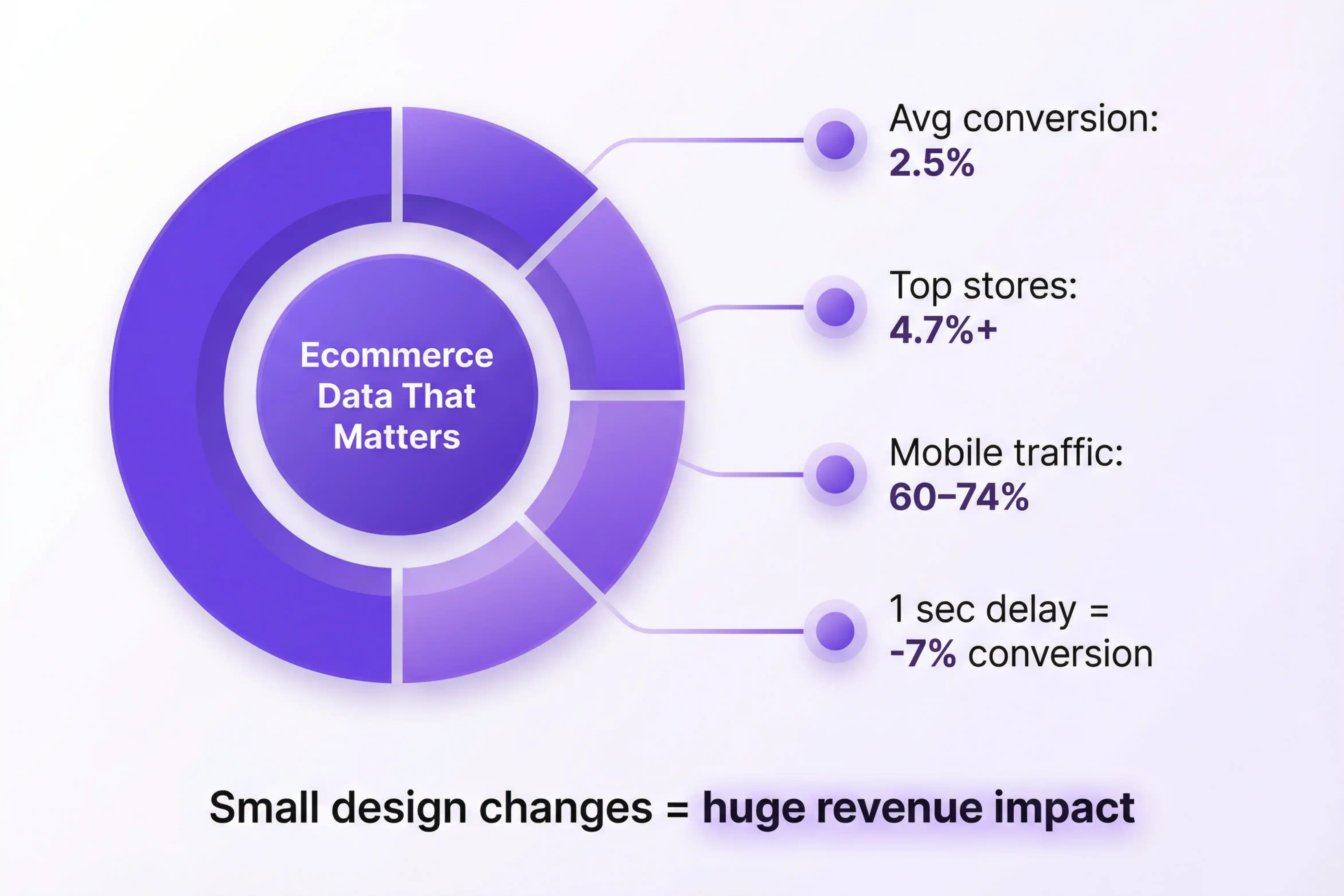
The global average ecommerce conversion rate is around 2.5% in 2026 — meaning roughly 2 to 3 out of every 100 visitors to your store actually buy something (Smart Insights, via Blend Commerce, 2026). The top-performing stores hit 4.7% and above.
That gap between average and top performers is not explained by better products or more traffic. It is explained almost entirely by design decisions — page speed, mobile experience, checkout flow, and trust signals.
Global ecommerce sales are projected to reach $6.88 trillion in 2026 (WiserReview, 2026). The market is enormous. The businesses that capture the most of it are not necessarily the ones with the biggest ad budgets — they are the ones with websites that remove every possible reason for a visitor to leave without buying.
Why Most Ecommerce Websites Lose Sales Before the Customer Even Buys
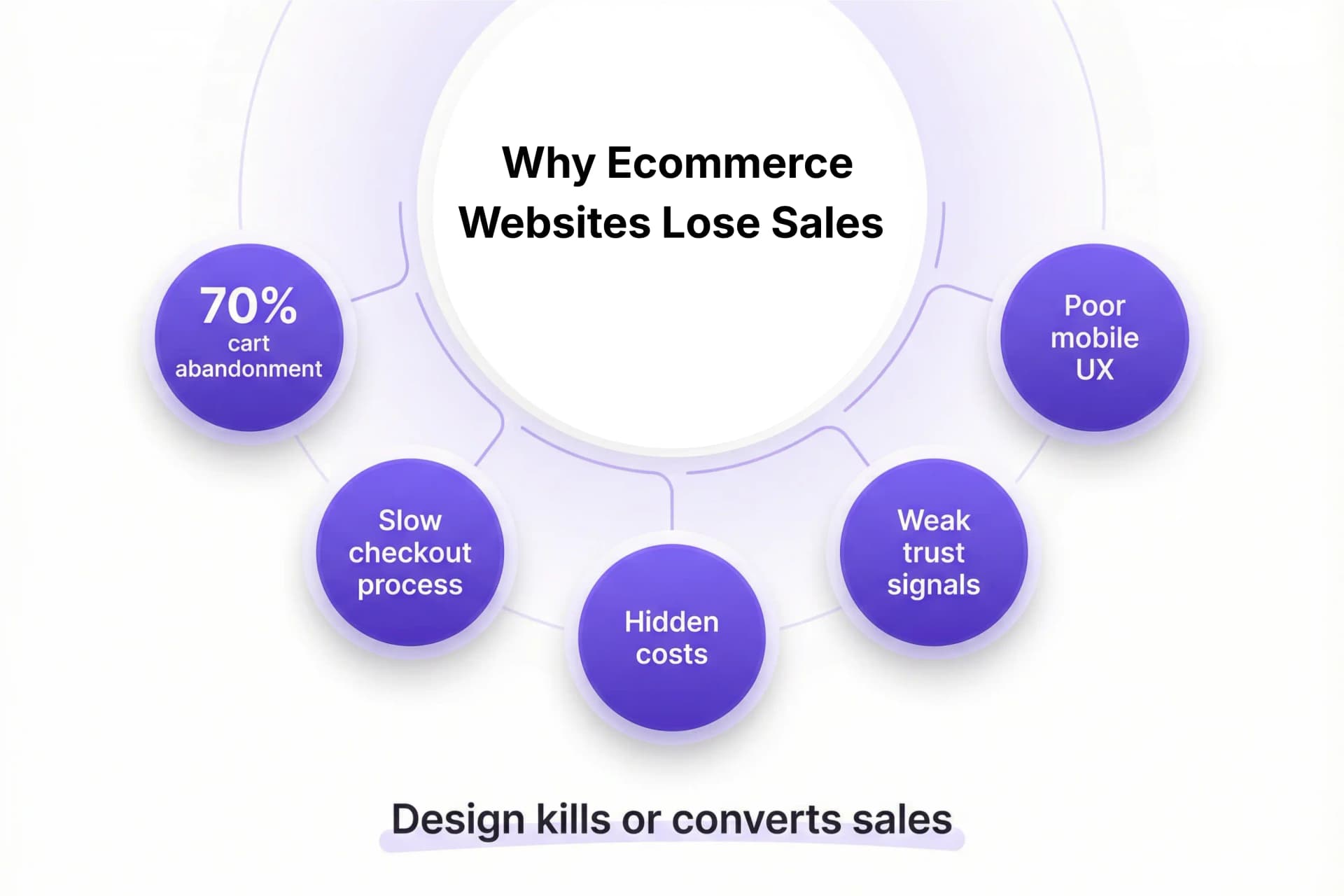
The average cart abandonment rate across all ecommerce businesses sits at 70% Baymard Institute. That means 7 out of every 10 people who add something to their cart leave without completing the purchase.
The reasons are almost always design-related:
- Checkout process is too long or complicated
- Unexpected costs appear at the last step — shipping, taxes, fees
- The site does not feel trustworthy enough to enter payment details
- The mobile experience makes completing the purchase frustrating
- There is no guest checkout option — account creation is required
Baymard Institute — the most cited research organisation in ecommerce UX — calculated that $260 billion in lost orders across the US and EU could be recovered through better checkout design alone. That is not a small number. And most of those fixes are design decisions, not technical ones.
Optimised checkout design can increase an ecommerce conversion rate by over 35%. — Baymard Institute
What Does Mobile-First Design Actually Mean for an Ecommerce Website?
Mobile drives 60–74% of all global ecommerce traffic in 2026 (WiserReview, 2026). But mobile converts significantly worse than desktop — 1.8% versus 3.9% (Blend Commerce, 2026). And mobile cart abandonment hits 79% compared to desktop's 68%.
The gap exists because most ecommerce sites are designed on a desktop and then made responsive as an afterthought. Mobile-first design means designing the phone experience first, then scaling up to desktop — not the other way around.
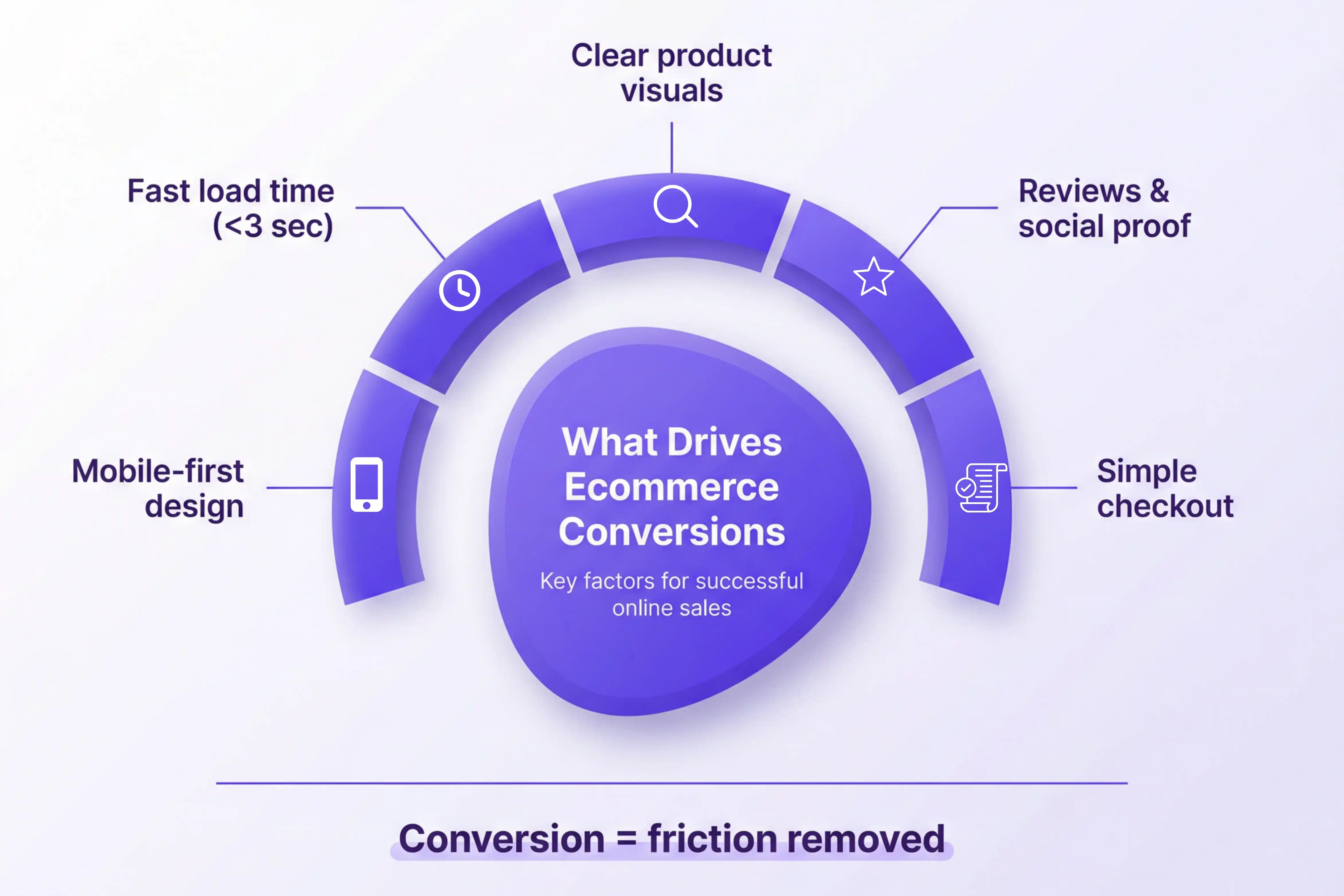
In practical terms, mobile-first ecommerce design means:
- Large, thumb-friendly buttons with enough spacing to avoid misclicks
- Simplified navigation that does not require precision tapping
- Auto-fill for shipping and payment fields to reduce form friction
- Apple Pay, Google Pay, and Shop Pay integration for one-tap checkout
- Images and videos optimised to load fast on mobile networks
- A checkout flow that works cleanly on a small screen without horizontal scrolling
A business that drives 70% of its traffic from mobile but converts at 1.8% is leaving an enormous amount of revenue on the table. Closing even a fraction of that gap — bringing mobile conversion from 1.8% to 2.5% — compounds significantly across thousands of monthly visitors.
How Does Page Speed Affect Ecommerce Sales?
This is one of the most directly measurable relationships in web design:
- Every 1-second delay in mobile load time reduces conversions by approximately 7% (Nostra AI)
- Pages loading in 1 second convert at 2.5x the rate of pages taking 5 seconds (Portent, via WordStream)
- 53% of mobile users abandon sites that take more than 3 seconds to load (Google)
- 63% of visitors bounce from pages that take over 4 seconds to load (Yottaa, 2025)
Walmart's internal research found that each 1-second improvement in page speed delivered +2% higher conversions (Blend Commerce, 2026). On a store doing $1 million in annual revenue, a 2% conversion improvement is $20,000. On a store doing $10 million, it is $200,000.
Page speed improvements — image compression, faster hosting, reduced JavaScript, CDN implementation — are among the highest-ROI investments an ecommerce business can make. They require no new traffic and no new products. They just convert the traffic you already have more effectively.
What Design Elements Build Enough Trust to Get Someone to Buy?
An ecommerce visitor who does not trust your site will not buy from it. Trust is not built through words — it is built through design signals that register subconsciously before a customer reads a single line of copy.
Social proof
Products with at least five reviews are 270% more likely to be purchased than products with none (Portent, via WordStream). Reviews are not optional — they are a core conversion element. How they are displayed, where they appear on the page, and whether they include photos all affect how much trust they generate.
Security signals
SSL certificates, recognised payment logos, security badges, and clear return policies are all trust signals. Their absence or poor placement creates anxiety at the exact moment a customer is deciding whether to hand over their payment details. That anxiety kills conversions.
Clear, transparent pricing
Surprise costs at checkout are the single biggest driver of cart abandonment. Displaying total cost — including shipping and taxes — early in the process, rather than revealing it at the final step, significantly reduces the drop-off at payment.
Professional visual design
92% of people consider well-designed websites more trustworthy, and 94% are more likely to stay on a site with an attractive layout. For ecommerce, this means high-quality product photography, a consistent visual identity, and a layout that feels polished and deliberate — not assembled from a template.
What Does a High-Converting Ecommerce Website Actually Look Like?
The answer is not a specific aesthetic — it is a set of functional decisions executed consistently:
- Fast load time on mobile — under 3 seconds
- Product pages with multiple high-quality images, zoom capability, and clear sizing information
- Social proof — reviews, ratings, and user-generated content — displayed prominently
- A checkout flow of 3 steps or fewer with guest checkout enabled
- Transparent total pricing before the payment step
- Multiple payment options including digital wallets
- Clear returns and refund policy, visible without digging
- Consistent branding that makes the site feel like a legitimate, established business
The businesses that outperform the 2.5% average do so by treating their website as a conversion tool, not a catalogue. Every page, every element, and every interaction is evaluated against one question: does this make it easier or harder to buy?
If your ecommerce website is getting traffic but not the sales to match, the problem is almost always in the design — not the product. Talk to the team at Relish about building or rebuilding your ecommerce website around conversion, not just aesthetics.
People Also Ask
- What makes a good ecommerce website design?
- How do I increase sales on my ecommerce website?
- What is a good ecommerce conversion rate?
- Why is my ecommerce website not converting?
- How important is mobile design for ecommerce?
- What is the best ecommerce website layout for conversions?
- How does page speed affect ecommerce sales?
