
MVP Development Agency: Brief It Right Before You Build
By Relish Team
MVP Development Agency: Brief It Right Before You Build
Most founders brief their MVP development agency the way they order at a restaurant they have never been to. They point at something vague and hope what arrives matches what they imagined. According to CB Insights, 42% of startups fail because there was no real market need for the product they built. The brief is where that failure usually starts.
This guide covers what a strong MVP development agency actually does, how much MVP development costs, how long it takes, and how to write a brief that gets the product built right — the first time.
What Does an MVP Development Agency Actually Do?
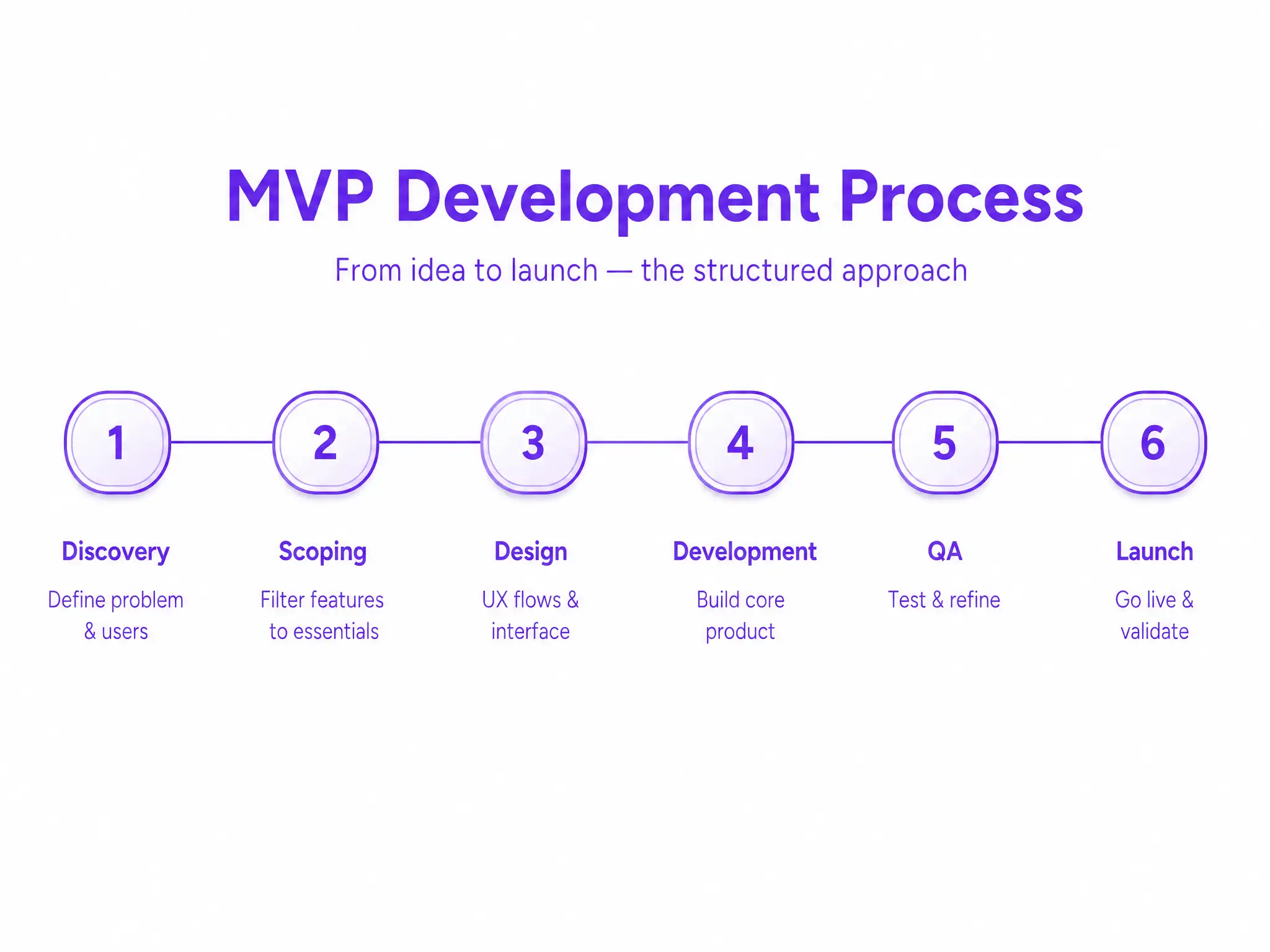
An MVP development agency takes your product idea through discovery, design, development and testing — building the most focused version of your product that can be validated with real users. Not the most impressive version. The most useful one.
The distinction matters. Building too much too fast is how startups burn through runway before they have learned anything. A strong MVP development agency is the thing that stops that from happening.
Discovery before development — why sequence matters
A reliable MVP agency starts with discovery — not wireframes, not code. Discovery is where your assumptions are challenged before any build begins. Who is the user? What problem are they trying to solve? What is the minimum functionality that proves the solution works? The Startup Genome Report found that startups which move through a structured discovery and validation phase are 3.6 times more likely to reach scale. Discovery is not a delay. It is protection.
Scoping: the feature filter every strong agency runs
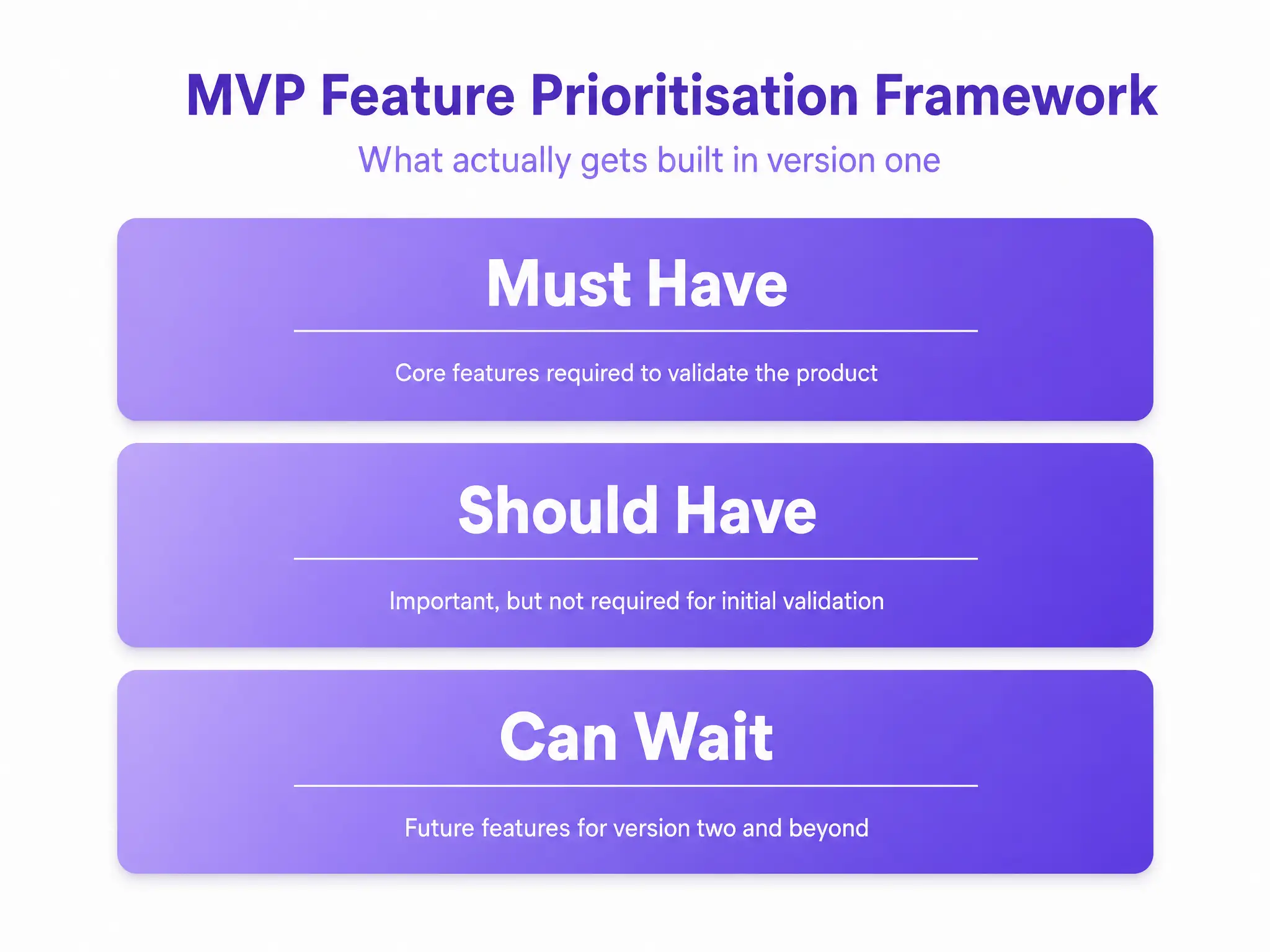
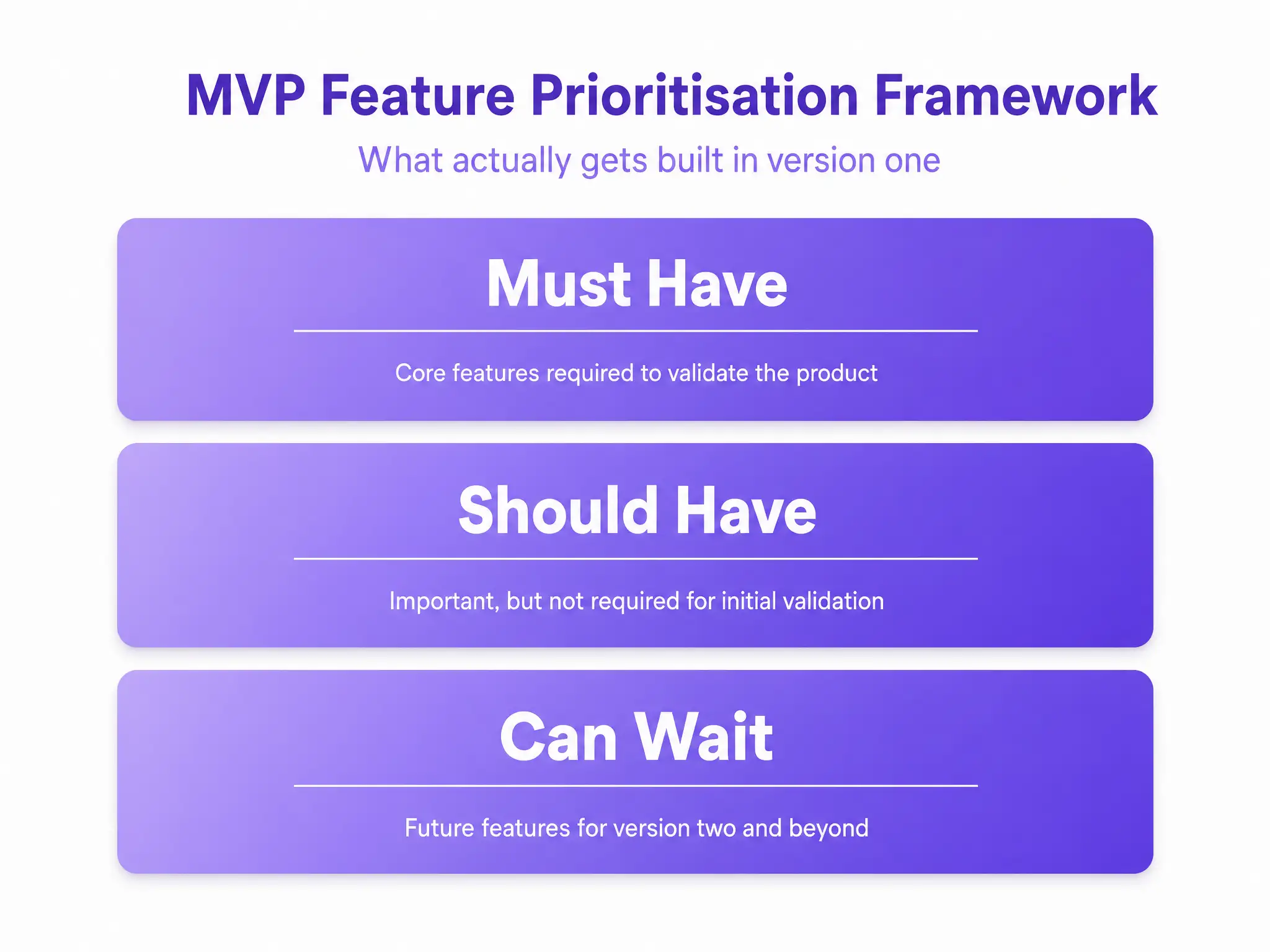
After discovery comes scoping. The agency defines exactly what gets built in the first version — and what waits. This document becomes the source of truth for the engagement. Most founders submit a feature list of twenty items. A good agency helps reduce that to five. Everything else goes into version two. Clarity at this stage is the single biggest predictor of a smooth build.
One coordinated team, not three separate vendors
An MVP development agency brings a product manager, designer and developers into a single coordinated process. This matters because every decision these roles make affects the others. A designer and backend developer who have not spoken to each other produce a product full of gaps. A coordinated team produces a product that holds together — and can be iterated on cleanly.
Related: What to build first in a SaaS MVP
How Much Does MVP Development Cost in 2026?
MVP development cost is the question most founders research before they brief any agency — and one most agencies avoid answering directly. The honest answer: it depends on scope, complexity and the agency's location. But here is the industry range that gives you a working benchmark.
A simple MVP with core features, limited integrations and a single platform typically falls between $15,000 and $40,000. A more complex MVP — SaaS platform, marketplace logic, third-party API integrations, multiple user roles — typically ranges from $40,000 to $80,000 or above. These ranges reflect global market rates based on publicly available industry research, not any single agency's pricing.
What drives MVP development costs up
- Number of user roles and permission levels in the product
- Third-party integrations — payment gateways, CRM systems, logistics APIs
- Custom UI/UX design vs templated or component-based design
- Mobile app build on top of web platform
- Real-time features — live chat, notifications, data dashboards
- Post-launch support and iteration included in the scope
Fixed price vs time and materials — what to ask for
For an MVP with a well-defined scope, a fixed-price engagement gives you budget certainty. For a product where requirements are likely to evolve during the build, a time-and-materials model gives you flexibility. Ask any agency you are considering which model they recommend for your situation — and why. The answer tells you a great deal about how they manage scope and risk.
Looking for an MVP development agency in the UAE, Singapore or Saudi Arabia?
Relish builds MVP products for startups and businesses across the UAE, Saudi Arabia, Singapore and globally. Discovery, design, development and launch — one team, one process, one outcome you can build on.
Talk to our MVP development teamHow to Choose the Right MVP Development Agency for Your Startup
The MVP development agency market is crowded. Every agency promises fast delivery, strong design and technical excellence. Here is how to cut through that and identify the agencies that will actually deliver.
Portfolio first — relevant builds over impressive credentials
Ask to see MVPs they have built — not websites, not brochures. An MVP for a SaaS platform, a marketplace or a mobile app involves different architectural and UX decisions than a marketing site. Relevant experience reduces your risk directly. Ask about the brief they received, the scope they defined, and how the product performed after launch.
Process over promises — what to ask before you commit
- How long is your discovery phase and what does it produce?
- Who specifically will work on our product — named people, not a team?
- How do you handle scope changes once development starts?
- What does the handover include at the end of the engagement?
- What post-launch support is included?
The agency that pushes back is the one worth hiring
If an agency accepts everything in your feature list without question, that is a signal. A strong MVP development agency challenges assumptions, cuts scope where it is bloated, and asks for clarity where the brief is underspecified. That friction early saves weeks and significant cost later. An agency that tells you what you want to hear is one that will tell you what went wrong after launch — not before it.
See also: Software architectural design services for startups
How to Write an MVP Brief That Actually Gets Results
A strong MVP brief does not describe the product you want. It describes the problem you are solving, the user it affects and what success looks like when the MVP is live. The agency uses that context to make better decisions at every stage of the build.
What belongs in a strong MVP brief
- The problem you are solving and who it affects most specifically
- Your core feature list — must-haves only, not a wish list
- Any user research, interviews or validation you have already done
- Preferred tech stack, if you have a view on it
- Timeline, budget range and any fixed external deadlines
- What success looks like measurably at the end of the MVP phase
The integration detail most founders leave out
Integrations. Payment gateways, third-party APIs, CRM connections, logistics systems, analytics platforms — these feel like fine print but they change the scope and timeline significantly. If your product connects to anything external, that belongs in the brief. Discovering it mid-build adds cost that a clear brief would have prevented entirely.
Questions to ask before signing anything
- Walk me through your process from brief to launch — step by step
- Who are the named people on our project?
- How do you manage and price scope changes?
- What exactly is included in post-launch support?
- Can I speak to a founder whose MVP you have built?
How Long Does MVP Development Take?
Most MVPs take 8 to 16 weeks from discovery to launch. Simple products with limited features and no complex integrations can reach launch in 8 to 10 weeks. More complex builds — SaaS platforms with multiple user roles, payment flows and third-party integrations — typically take 12 to 16 weeks.
The biggest variable in MVP development timelines is not the agency's speed. It is the clarity of the brief and the speed of client feedback during the build. An agency working from a clear, detailed brief with a responsive client will almost always deliver faster than the same agency working from an ambiguous one.
What a Successful MVP Looks Like After Launch
Users are generating signal, not silence
A successful MVP does not need to be perfect. It needs to generate information. Real user behaviour — what features they use, what they ignore, where they drop off — tells you what to build next. If the product is live and generating no meaningful signal, the problem is either the wrong users or the wrong problem at the core.
The codebase supports the next version without a rebuild
A product built on solid technical foundations can be extended without dismantling what already works. New features are added cleanly. Performance holds as users grow. If every iteration requires rebuilding, the architectural decisions made during the MVP need revisiting — which is why choosing an MVP development agency that thinks beyond version one matters from the start.
Your agency relationship outlasts the launch
The best MVP development agencies are not looking to hand the product over and disappear. They want to know how it performed, what users said and what the next phase looks like. An ongoing relationship with an agency that understands your product is one of the most commercially valuable things to come out of a well-run engagement.
Frequently Asked Questions About MVP Development Services
What does an MVP development agency do?
An MVP development agency takes your product idea through discovery, design, development and testing to build the most focused version of the product that can be validated with real users. The engagement typically includes scoping, UX design, frontend and backend development, QA and launch support.
How much does MVP development cost?
MVP development typically costs between $15,000 and $80,000 depending on product complexity, number of integrations, design requirements and the agency's location. Simple products with core features cost less; complex SaaS platforms with multiple user roles and integrations cost more.
How long does MVP development take?
Most MVPs take 8 to 16 weeks from discovery to launch. The timeline depends on scope complexity and the speed of feedback during the build. A clear, detailed brief at the start is the single biggest factor in keeping timelines on track.
What is the difference between an MVP and a prototype?
A prototype is a visual simulation used to test ideas and flows. An MVP is a working product used to test real market demand with real users. A prototype cannot be used by customers. An MVP can — and is designed specifically to generate user feedback at scale.
How do I choose the right MVP development agency for my startup?
Look for an agency with a relevant portfolio of similar products, a defined discovery process before development starts, named team members assigned to your project, transparent scope management and post-launch support included in the engagement. Ask to speak with a founder they have previously built for.
Ready to brief your MVP development agency?
Relish builds MVP products for startups and businesses across the UAE, Saudi Arabia, Singapore and globally. We handle discovery, design and development — so you launch with a product that works, not one that needs to be rebuilt.
Start the conversation with our team