
Website Revamp or Rebuild: One Saves Time, One Saves Your Business
By Relish Team
Website Revamp or Rebuild: One Saves Time, One Saves Your Business
Two businesses. Same problem. Website looks dated, traffic is flat, leads have stopped coming through. One gets a website revamp. One gets a full rebuild. Twelve months later, one of them made the right call. This guide helps you figure out which path is right for your business — before you spend the budget finding out the hard way.
Stanford Web Credibility Research found that 75% of users judge a company's credibility based on its website design. Your website is not a marketing asset. It is the first decision your potential customer makes about whether to trust you at all.
Website Revamp vs Rebuild: What Is the Difference?
Most businesses frame this decision around how the site looks. That is the wrong lens. A website can look completely dated and still have a structure sound enough to revamp efficiently. A website can look perfectly fine and be so technically constrained that only a full rebuild will solve the real problem.
What a revamp covers and what it cannot fix
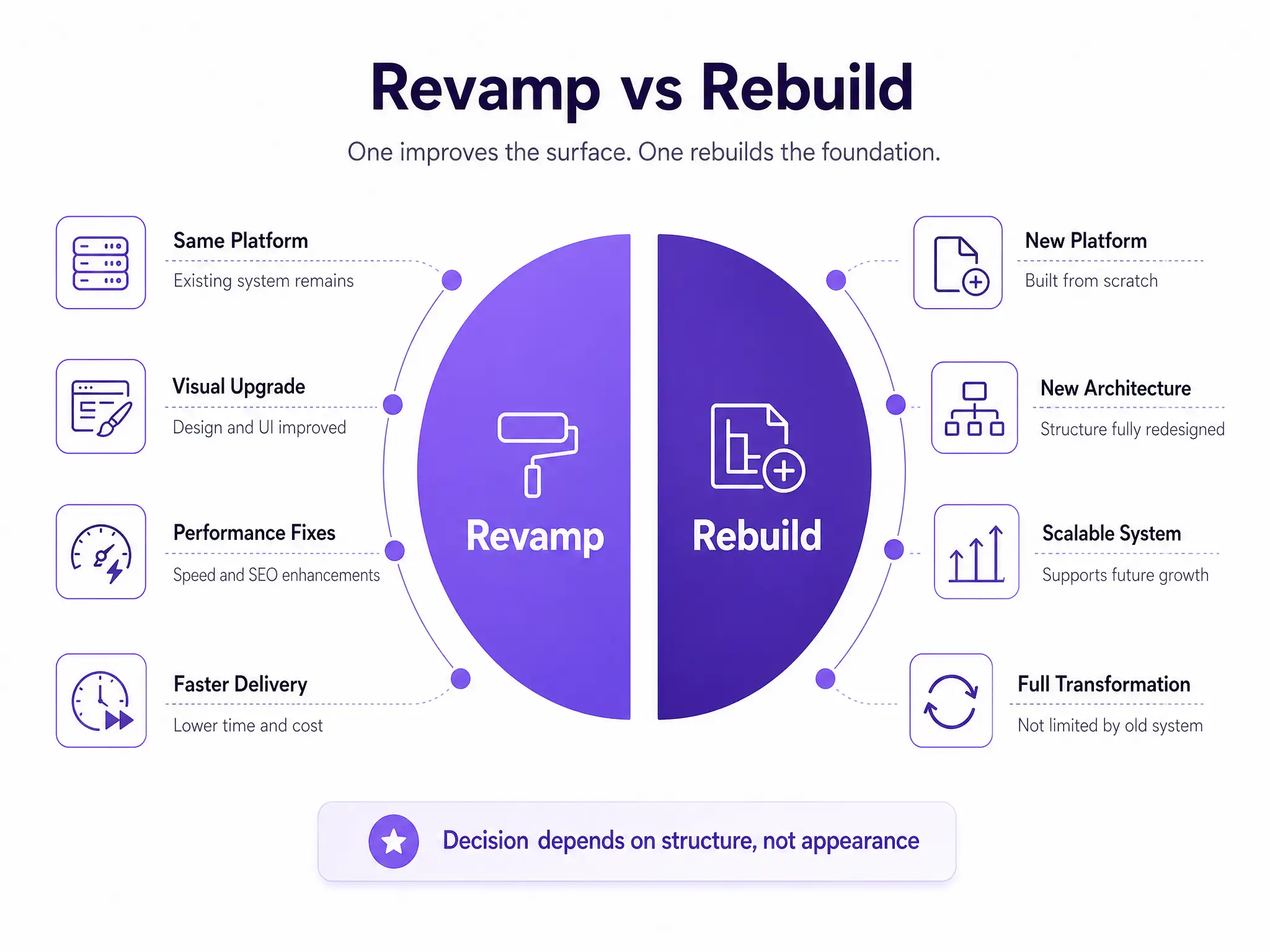
A website revamp improves the surface — the visual design, the messaging, the performance, the SEO. The platform, the codebase and the underlying structure stay in place. A well-executed revamp is faster and less disruptive than a rebuild. Done when a rebuild is what was actually needed, however, it wastes budget without solving the core problem. The decision needs to be based on diagnostics, not aesthetics.
What a rebuild actually involves
A rebuild is a new website. New platform, new architecture, new everything. The existing site is a reference — not a foundation. It is a larger investment of time and money, and the right answer when the existing platform simply cannot support what the business needs from it next.
The mistake businesses make when deciding
Deciding based on visual judgment rather than performance data. A good website redesign agency runs diagnostics — platform capability, Core Web Vitals scores, technical audit results — before recommending which path to take. If an agency recommends a path without asking about your platform, your performance data or your growth requirements, ask why.
Signs Your Website Needs a Revamp
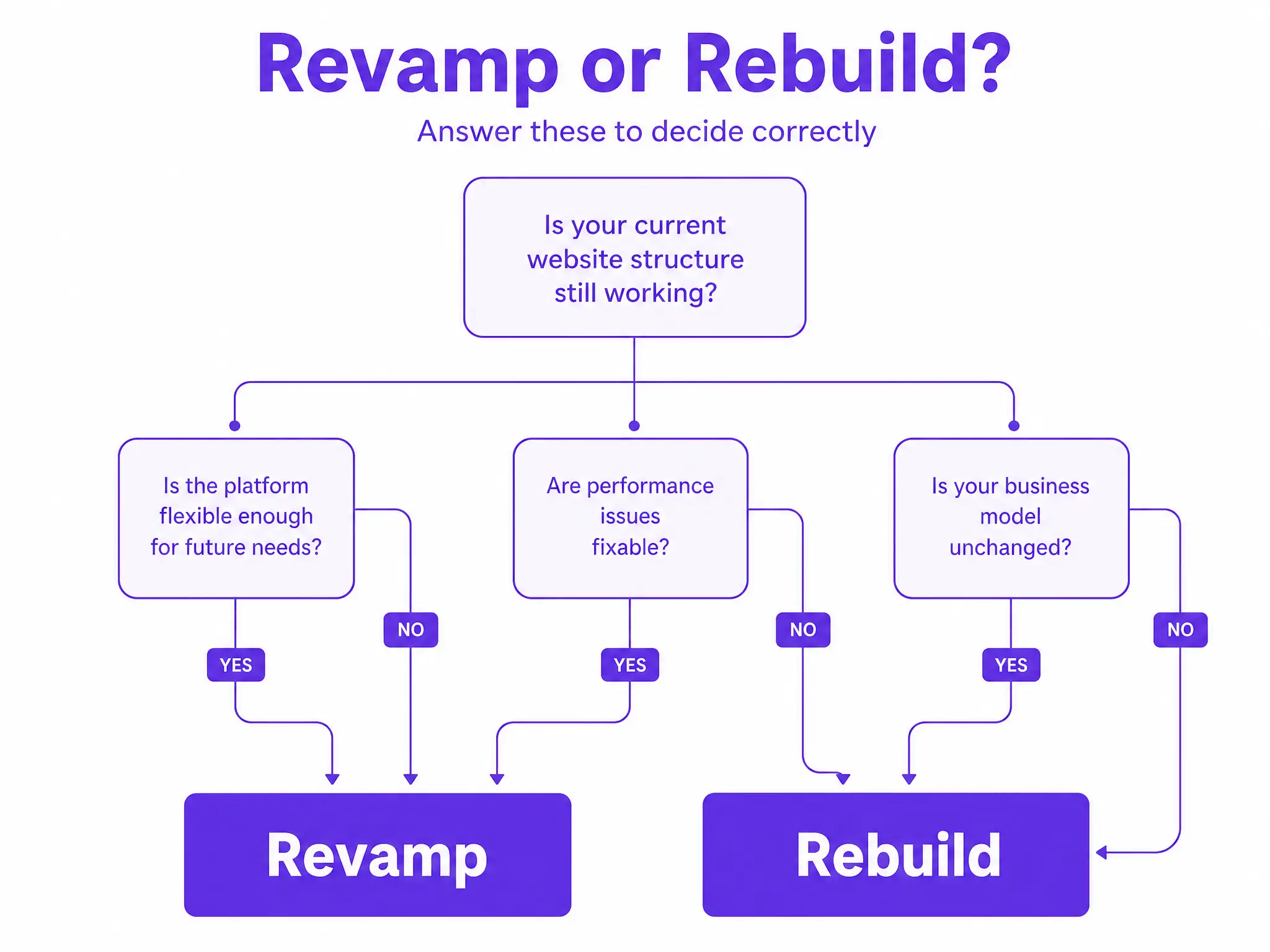
A revamp is the right path when the structural foundation is sound and the issues are primarily visual, content-related or performance-related. Here are the clearest signals.
The design no longer reflects where the brand is
If the business has evolved but the website has not, a revamp updates the visual language — typography, colour, imagery, layout — to reflect the brand as it actually exists today. This is one of the most common and most straightforward revamp cases, and one of the most impactful when executed well.
Messaging has drifted from the current audience
Copy written for an earlier version of the business rarely connects with the audience the business serves today. A revamp is the opportunity to rewrite the positioning, clarify the value proposition and make every page earn the attention it receives. This is content work, not structural work — and it does not require a new platform to execute.
Performance and Core Web Vitals are fixable without a rebuild
According to Google's Core Web Vitals research, page load time, layout stability and interactivity directly affect both user experience and search engine ranking. If your Core Web Vitals scores are poor but the issues are rooted in unoptimised assets, third-party scripts and image sizes rather than platform architecture — a focused revamp can address all of this within the existing site.
Signs Your Website Needs a Full Rebuild
A rebuild is the right answer when the existing platform is the problem — when no amount of surface improvement will resolve what is structurally broken or structurally limited.
The platform cannot do what the business now needs
Adding ecommerce to a brochure site. Moving from a simple blog to a platform with user accounts, booking systems and third-party integrations. Attempting these within an unsuitable existing structure creates technical debt that grows faster than the business does. The rebuild, in these cases, is not a cost — it is the prevention of a significantly larger one.
The codebase has become unmanageable
Every patch, workaround and quick fix leaves a trace. When changes in one area of the site consistently break things in another — when developers are reluctant to touch anything because the consequences are unpredictable — the codebase has become too complex to extend cleanly. This is a structural problem. A revamp cannot fix it.
The business model has fundamentally changed
A website built for a business at an earlier stage of growth often cannot accurately represent the business at a later one — not because of how it looks, but because of what it is structurally able to do. New audiences, new services and new conversion goals sometimes require a new site rather than a better version of the old one. See also: Why high-traffic pages fail to convert — SEO and UX guide
Not sure whether your website needs a revamp or a full rebuild?
Relish designs and builds websites for businesses across the UAE, Middle East and globally. We assess what you have, tell you honestly what it needs, and deliver it — revamp or rebuild, built to perform.
Talk to our website design teamHow Much Does a Website Revamp Cost in 2026?
Website revamp cost varies significantly depending on scope, platform and what the engagement includes. Here are the general ranges based on industry benchmarks.
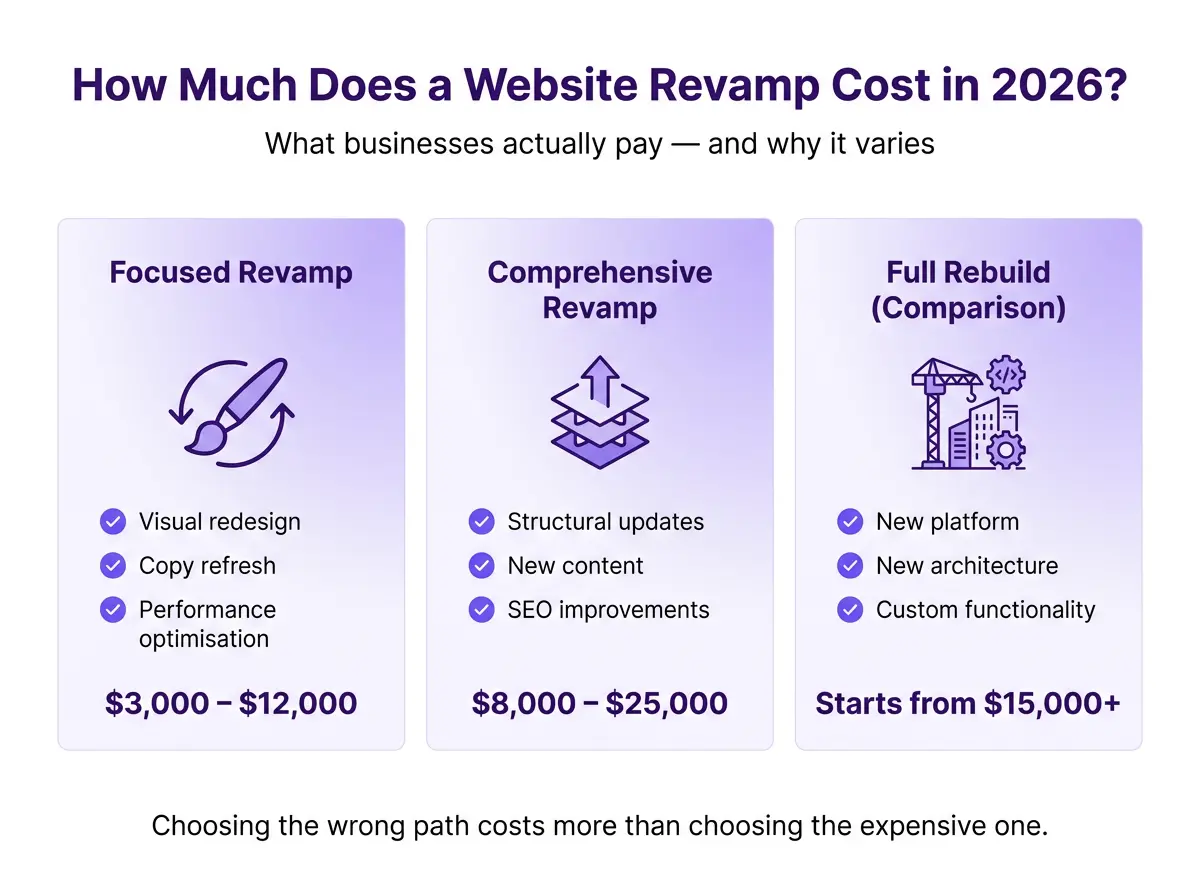
A focused revamp of a five to fifteen page business website — covering visual redesign, copy refresh and performance optimisation — typically ranges from $3,000 to $12,000. A more comprehensive revamp involving structural changes, new content and SEO work ranges from $8,000 to $25,000.
A full website rebuild of a similar size site typically starts from $15,000 and scales upward depending on platform, custom functionality and integration requirements. The gap between revamp and rebuild cost is real — which is why getting the diagnosis right before committing to either path matters.
How Long Does a Website Revamp or Rebuild Take?
A focused revamp of a five to fifteen page business website typically takes four to eight weeks. A more extensive revamp involving new copy, structural changes and performance work takes eight to twelve weeks.
A full rebuild of a similar site typically takes twelve to twenty weeks — from discovery through to launch. The variable that most affects timeline on either project is the speed of client feedback and content delivery, not agency build capacity. A brief with clear content and fast approval cycles will always compress a timeline.
How to Choose the Right Website Redesign Agency
They start with business goals, not design concepts
A strong website redesign agency starts by understanding what the site needs to achieve for the business — not by presenting visual concepts. Before any design work begins, they should be asking about target audience, conversion goals, how customers currently arrive on the site and what success looks like six months after launch.
Their portfolio includes projects like yours
Look for case studies that match your sector and scale. An agency with relevant experience brings tested assumptions to your project — reducing risk directly. Ask about the brief they received, what they delivered, and what the performance metrics looked like after launch. According to Nielsen Norman Group's research on web UX, sites that improve task completion rates and reduce cognitive load consistently outperform those optimised primarily for aesthetics. Ask agencies how they measure these outcomes.
Scope clarity before a single wireframe
The agencies that deliver the best website projects define scope clearly before any design work begins — how many pages, what content work is included, whether SEO is in scope, and what post-launch support looks like. Ambiguity in the scope conversation almost always becomes friction mid-project. Push for specificity before you sign.
What a Successful Website Project Delivers
The site converts visitors, not just attracts them
The measure of a successful website project is not how it looks — it is how it performs. Conversion rate, time on page, bounce rate and the number of qualified enquiries generated in the months after launch are the metrics that tell you whether the project achieved its goals. Define these benchmarks before the project starts, not after it ends.
Your team manages it independently
One of the most practical measures of a well-built website is how independently your team can operate it. Adding pages, updating content, publishing blogs and reviewing analytics should all be achievable without briefing a developer for every change. A site that empowers the team operating it costs less to maintain and stays more current over time.
You are not planning the next project in six months
A website project that solves the right problem gives you two to three years before the conversation needs to happen again. If you are already planning a follow-up project within twelve months of launch, either the wrong path was chosen or the brief was not specific enough. Both are preventable with the right agency and the right process.
Frequently Asked Questions About Website Revamp Services
What is the difference between a website revamp and a rebuild?
A revamp improves the visual design, messaging and performance of an existing site without changing its platform or structure. A rebuild is a new site on a new foundation. A revamp is faster and less expensive; a rebuild is necessary when the existing platform cannot support what the business needs.
How much does a website revamp cost?
A website revamp typically costs between $3,000 and $25,000 depending on scope, the number of pages and what the engagement includes. Focused revamps covering visual design and performance optimisation cost less; comprehensive revamps including structural changes and new copy cost more.
How long does a website revamp take?
A focused website revamp of a five to fifteen page business site typically takes four to eight weeks. A more comprehensive revamp involving structural changes and new copy typically takes eight to twelve weeks. The biggest variable is the speed of content delivery and feedback from the client side.
Will a website revamp improve my search rankings?
A revamp that includes Core Web Vitals improvements, updated heading structure, refreshed meta tags and stronger internal linking can meaningfully improve organic search rankings. SEO improvements are most effective when planned as part of the revamp — not added as an afterthought after the design work is done.
What should I look for in a website revamp agency?
An agency that starts with business goals rather than design concepts, has a portfolio with relevant projects, communicates clearly about scope and timelines, and tells you honestly whether a revamp or a rebuild better serves your situation. Honesty before the project starts is a reliable signal of reliability during it.
Ready to make your website work harder for your business?
Relish designs and builds websites for businesses across the UAE, Middle East and globally. Whether your site needs a focused revamp or a full rebuild, we deliver websites that are fast, clear and built to convert.
Get in touch with our website design team