
When Should You Rebrand Your Business? The Signs That Actually Matter
By Relish Team
Rebranding is one of the most significant investments a business can make — and one of the most commonly mistimed ones. Some businesses rebrand too early, discarding equity they had barely built. Others hold on too long, watching their brand quietly work against them while competitors move ahead.
This guide cuts through the noise and gives you a clear, honest framework for deciding when a rebrand is genuinely the right move — and when it is not.
What Is Rebranding and Is It the Same as a Brand Refresh?
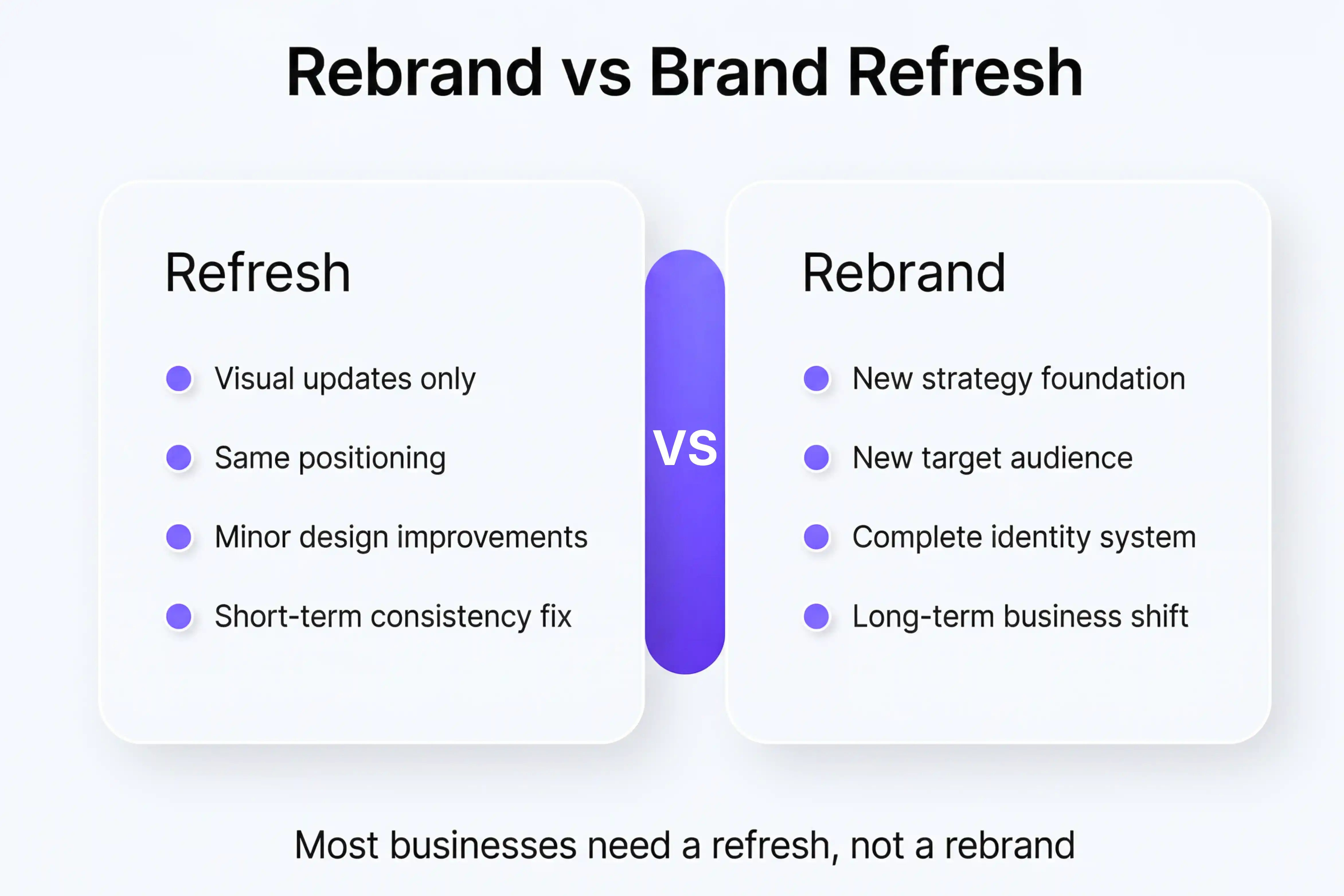
These two terms get used interchangeably, but they describe very different exercises.
A brand refresh is a refinement of what already exists. You might update the colour palette, modernise the logo, tighten the typography, or sharpen the messaging. The core identity stays the same — it just becomes more current and more consistent.
A rebrand is a strategic repositioning. It involves redefining what the business stands for, who it serves, and how it communicates — then rebuilding the visual and verbal identity from that foundation. The result is a brand that represents a fundamentally different version of the business, not a polished version of the old one.
Most businesses that think they need a rebrand actually need a refresh. A few genuinely need a full rebrand. Knowing which one is right starts with understanding why you are considering the change.
What Are the Real Signs Your Business Needs a Rebrand?
According to a Bynder survey of 1,002 marketers, 82% of marketing professionals have worked on a rebranding project. The most common trigger — cited by 57% — was the need to update brand identity. But behind that surface answer are specific, concrete situations that justify the investment.
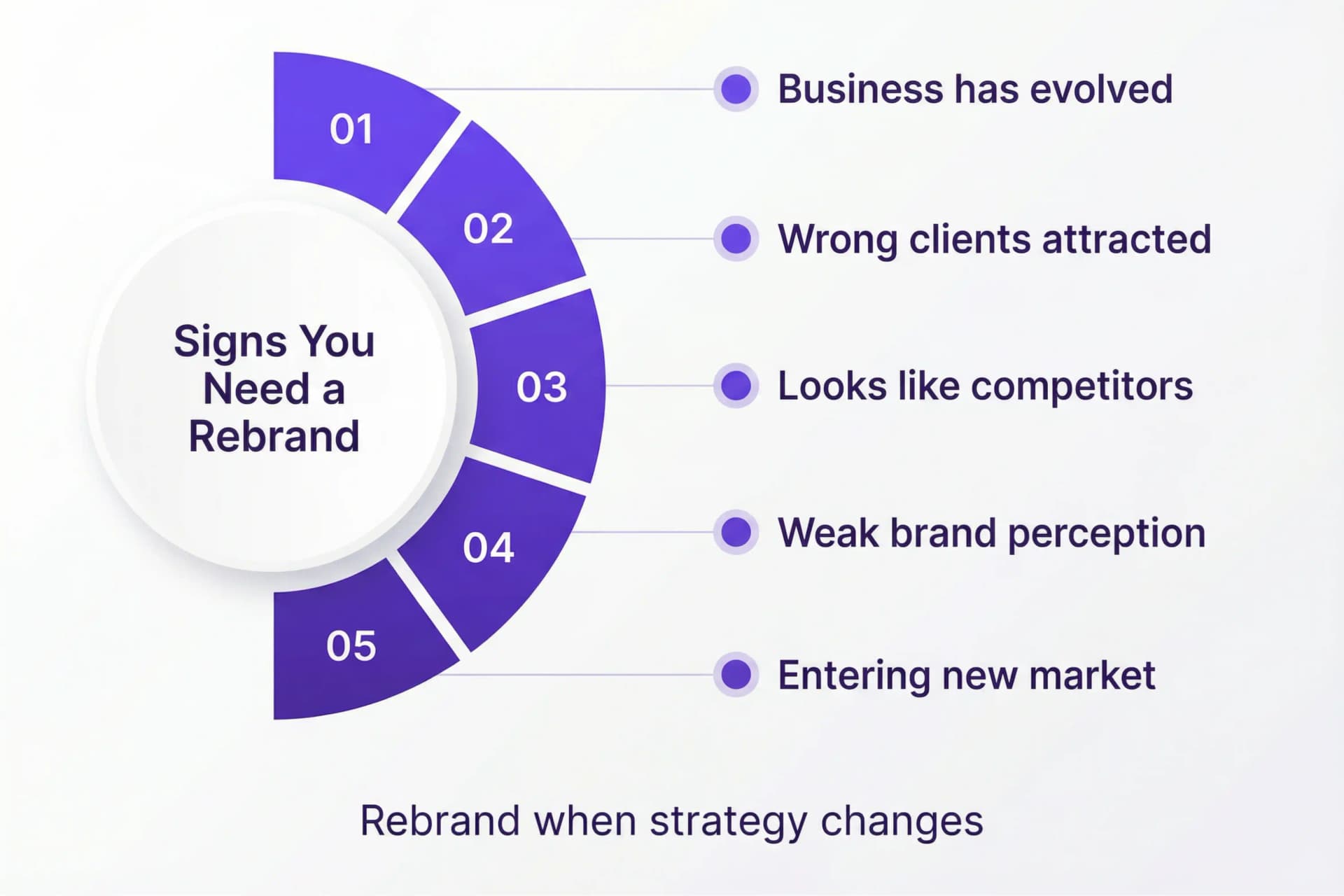
Your business has grown beyond what your brand says about it
This is the most common legitimate reason to rebrand. The business you are today is fundamentally different from the business you were when the brand was built — different services, different client size, different markets, different ambitions. But the brand still tells the old story. Potential clients evaluate you against what they see, not what you know you can deliver. A brand that undersells the business is quietly costing you the clients you want most.
You are attracting the wrong clients consistently
If your enquiries consistently come from clients outside your ideal profile — wrong budget, wrong industry, wrong project size — your brand is sending the wrong signal. This is not a sales problem. It is a positioning problem. The brand is attracting the audience it speaks to, and if that audience is wrong, the brand needs to change.
Your brand looks identical to your competitors
In a crowded market, a brand that blends in is a brand that loses by default. If a potential client could swap your logo for a competitor's and the communication would still make sense, you have no differentiation. Rebranding to establish a distinct position is not vanity — it is a commercial necessity.
You are embarrassed to share your website or marketing materials
This is a signal that is easy to dismiss but important to take seriously. If you hesitate before sharing your website with a potential client, before handing over a business card, before linking to your portfolio — that hesitation has a cost. Every time you qualify your brand before anyone sees it, you are already losing credibility.
You are entering a new market or significantly expanding your services
A brand built for one market, one audience, or one service category does not automatically translate to a new one. Entering new territory with an old brand creates positioning confusion — both for the new market and for your existing clients.
45% of rebranding efforts fail due to poor stakeholder communication and weak strategic alignment. A rebrand is not a design project — it is a business decision. — LO:LA Agency, March 2026
When Is the Wrong Time to Rebrand?
Not every impulse to rebrand is justified. These are the situations where rebranding is the wrong answer:
- You are bored with your brand — boredom is not a business reason. Your clients may not share it.
- Sales are down and you want a quick fix — rebranding addresses positioning, not pipeline. If the problem is sales process, pricing, or product, a new logo will not solve it.
- A competitor just rebranded — their reasons for rebranding are not your reasons. Reactive rebranding produces weak results.
- You have just launched — a brand built less than two years ago has not had enough time to accumulate the equity that justifies discarding it.
- You have not diagnosed the actual problem — if you cannot articulate specifically why the current brand is not working, you are not ready to rebrand.
What Does a Business Rebrand Actually Involve?
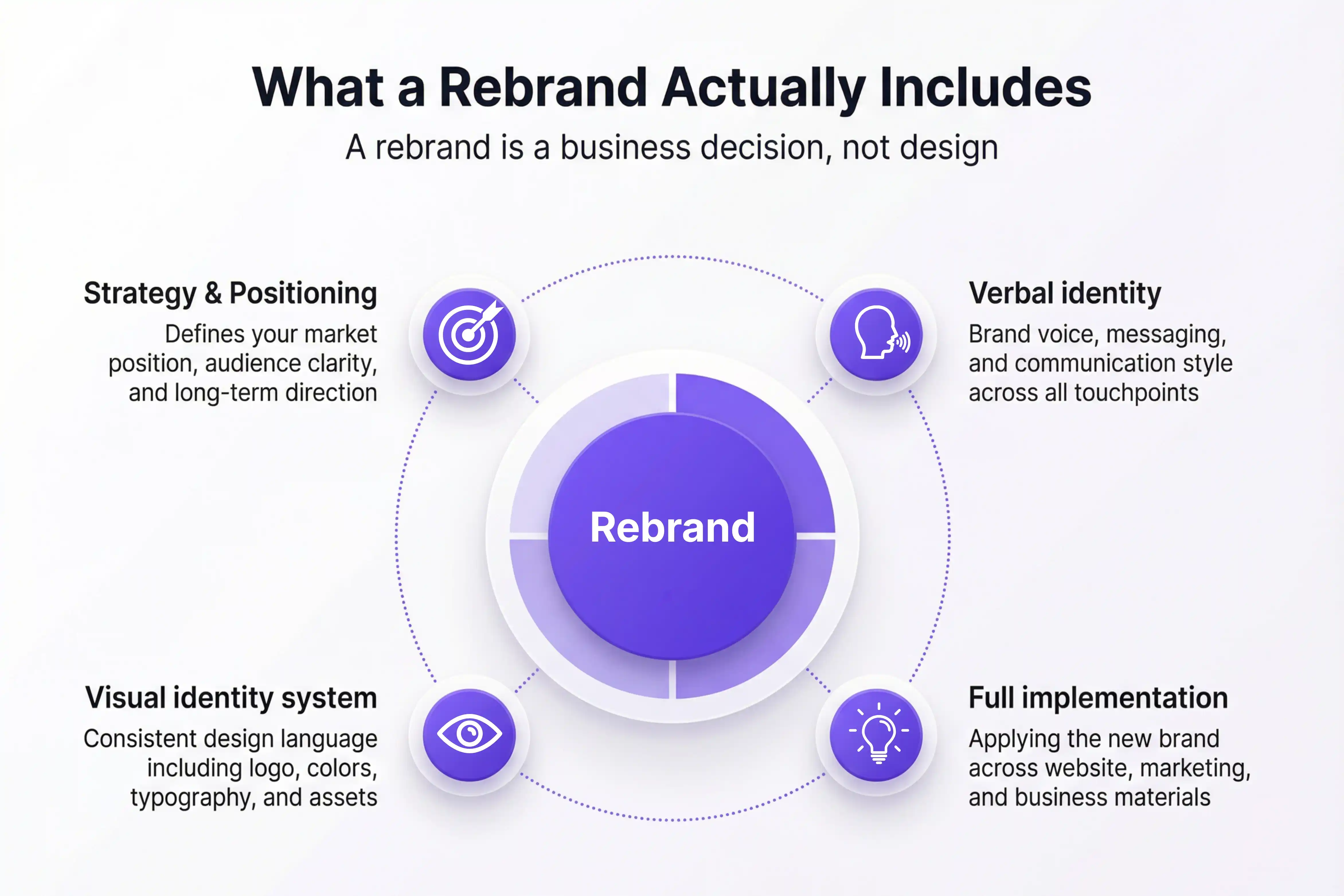
A rebrand is not a logo redesign. It is a structured process that starts with strategy and ends with a complete identity system applied consistently across every touchpoint.
1. Brand strategy and positioning
This is the foundation. Before any design work begins, the business needs to be clear on who it serves, what it offers that competitors do not, how it wants to be perceived, and what it stands for. Strategy defines everything that comes after. Without it, a rebrand is just a visual change with no commercial direction.
2. Visual identity
Logo, colour palette, typography, imagery style, and the rules governing how all of these are used. A complete visual identity is not a logo file — it is a system that works consistently across every application, at every size, on every surface.
3. Verbal identity
The words the brand uses. Tone of voice, key messages, how the business describes what it does and for whom. Visual identity and verbal identity must be built together — a brand that looks premium but writes like a startup creates a disconnect that undermines both.
4. Implementation
Updating the website, social media profiles, marketing materials, email signatures, proposal templates, and any physical collateral. This is where most rebrands stall — the strategy and design are done, but the rollout is incomplete, and the brand looks inconsistent across channels for months.
Relish handles brand strategy, visual identity, and digital execution as one connected process — so the positioning that is defined in strategy actually shows up in the design and the website. See how our Brand Strategy and Identity service works.
How Long Does a Rebrand Take?
Based on a survey of 1,002 marketers, Bynder found that the average rebrand takes seven months from initial conversations to full rollout. Complex rebrands involving multiple markets, product lines, or large teams can take 12 months or longer.
The timeline is driven by: how clearly the business can articulate what it needs, the complexity of the visual identity system required, the number of stakeholders involved in approvals, and how thoroughly the implementation is executed across all channels.
Businesses that try to compress the timeline significantly almost always pay for it in the quality of the strategic work — which is where the commercial value of the rebrand is actually created.
How Do You Rebrand Without Losing Your Existing Customers?
This is the concern that stops most businesses from rebranding when they should. The reality is that a well-executed rebrand rarely loses existing clients — it tends to strengthen relationships by making the business's value clearer.
The key principles:
- Communicate the why — existing clients deserve to understand what has changed and why. A brief, direct explanation positions the rebrand as growth, not instability.
- Maintain continuity in your relationships — the people, the service quality, and the commitment to clients does not change. Make that clear.
- Do not change everything at once — a phased rollout that prioritises the highest-visibility touchpoints first gives clients time to adjust.
- Involve key clients early — sharing the new direction with your most important clients before the public launch turns them into advocates rather than observers.
The businesses that lose clients in a rebrand are almost always the ones that changed without communicating, or changed in ways that genuinely altered what made them valuable. A strategic rebrand — one grounded in what the business is and where it is going — almost always strengthens client relationships rather than disrupting them.
If you are not sure whether your business needs a rebrand or a refresh, start with a free brand review at Relish. We will give you an honest assessment and a clear recommendation — even if that recommendation is that nothing needs to change yet.
People Also Ask
- When should a business rebrand?
- What is the difference between a rebrand and a brand refresh?
- How do I know if my business needs a rebrand?
- How long does a rebrand take?
- How much does a rebrand cost?
- How do you rebrand without losing customers?
- What does a full rebrand include?
